
Al-Hasakah Water Crisis Worsens; Women Demand Reactivation of Alouk Station
Al-Hasakah residents suffer from a severe water crisis due to the Alouk station shutdown, with women bearing the heaviest burden of securing water daily.
RONIDA HAJI
Al-Hasakah– The city of Al-Hasakah in Rojava continues to suffer from a suffocating water crisis following the prolonged shutdown of the Alouk water station, which is one of the main sources of drinking water for hundreds of thousands of residents in the city and its countryside.
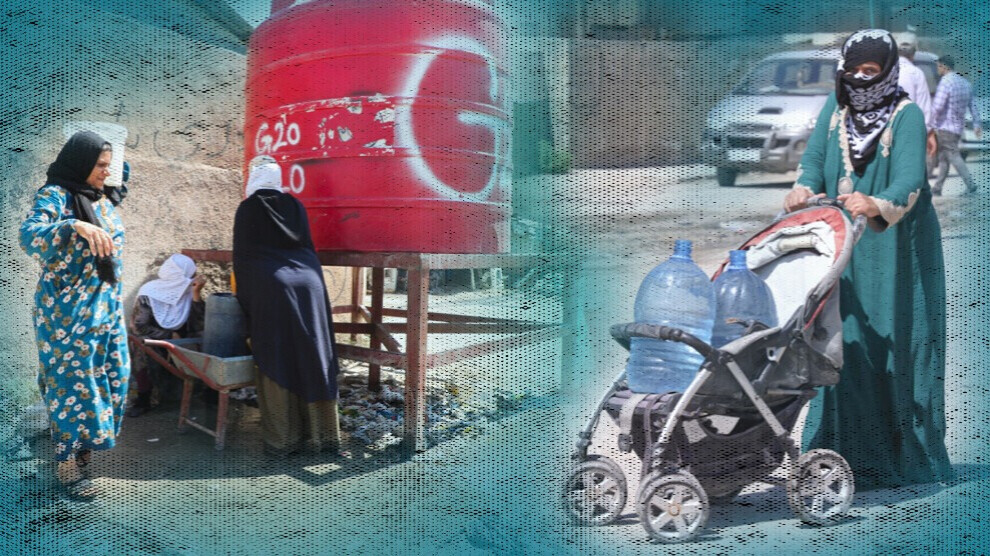
Women and children bear the heaviest burden of this crisis, as they are forced daily to fetch drinking and domestic water, carrying it on foot in jerrycans under grueling conditions.
Despite repeated promises to find a solution, the humanitarian crisis in Al-Hasakah persists, and residents continue to appeal to the relevant authorities to expedite an end to this suffering and secure water for the population.
The Alouk Station: A Lifeline for Al-Hasakah
The Alouk water station is located east of the city of Serekaniye/Ras al-Ayn, near the Syrian-Turkish border, and is considered one of the most important sources of drinking water in North and East Syria. Water is extracted from groundwater wells and then pumped through a network of pipelines to the city of Al-Hasakah, the town of Tell Tamer, and dozens of surrounding villages.
Before 2019, the station operated normally, providing drinking water to hundreds of thousands of residents. However, following the offensive launched by Turkey and its mercenary factions against the cities of Serekaniye/Ras al-Ayn and Gire Spi/Tell Abyad on October 9, 2019, the station went out of service. This triggered a severe humanitarian crisis, leaving hundreds of thousands of civilians without a stable source of drinking water.
Residents Rely on Water Tankers and Private Wells
The Alouk station supplies drinking water to the city of Al-Hasakah, Tell Tamer, villages along the pipeline, and displaced persons' camps. According to UN data, nearly 460,000 people rely directly on the station, while the impact of its shutdown extends to affect approximately one million people.
The crisis has led to a severe shortage of clean water and a surge in prices, forcing residents to buy water from mobile tankers or rely on private wells. This situation also increases the risk of spreading waterborne diseases due to the use of unsafe water.
Residents believe that Turkey has used the Alouk station as a card for leverage and a weapon of war against the region's population, exerting immense pressure on civilian lives and deepening the humanitarian crisis.
Women of Al-Hasakah Demand Restoration of Alouk Station
Speaking to our agency, a woman from Al-Hasakah demanded an urgent solution to the crisis regarding the operation of the Alouk station, asserting that "the government must shoulder its responsibility and restore the station." Fatima Hussein, a resident of the Al-Aziziyah neighborhood in Al-Hasakah, explained that women are severely affected by the situation. Unable to afford water from private tankers due to high prices, they go daily to neighborhood water tanks and carry water to their homes on their shoulders or transport the containers using baby strollers. She described the physical exhaustion, stating that they can no longer bear such a burden, especially given the summer heat, and emphasized that restarting the Alouk station would bring relief to the people of Al-Hasakah.
For her part, Amina Ali—also a resident of the Al-Aziziyah neighborhood—confirmed that the shutdown of the Alouk station has become the primary cause of numerous crises facing the area. "Our children have suffered from stomach ailments and other illnesses due to the water crisis. How long must we continue to suffer? Hauling water daily has exhausted us and taken a heavy toll on our shoulders." She called on the relevant authorities to take serious and swift measures to address the crisis, stating, "Access to drinking water is a fundamental human right that must be guaranteed without delay."
Crisis Persists Despite Handover of Station Management
It is worth noting that, following the agreement signed on January 29 between the Syrian Democratic Forces (SDF) and the Syrian Interim Government, the management of the Alouk water station was handed over on April 8, 2026. Despite this move and repeated promises to resolve the water crisis, the humanitarian situation in the city of Al-Hasakah remains unresolved, while residents continue to demand an urgent solution that restores the station's operation and ensures the delivery of drinking water to the entire population.