
A Yemeni Woman Protects Yemeni Heritage from Extinction Through Her Project
Hana Al-Sharjabi,a displaced Yemeni woman,preserves traditional clothing through her project.starting with a needle and thread,she revives heritage with modern touches while protecting it from extinction.
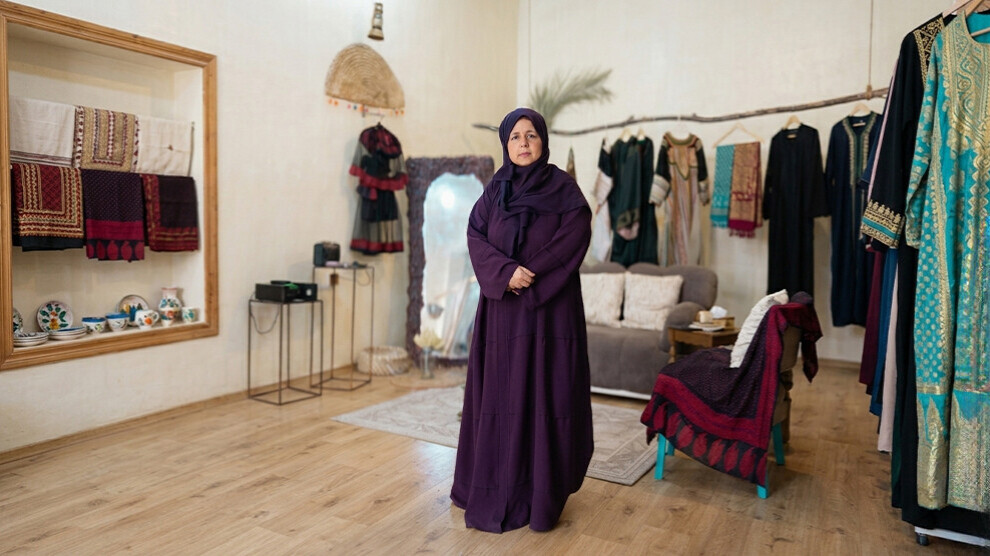
RAHMA SHANZOOR
Yemen — At a time when conflict and displacement threaten much of Yemen's cultural heritage with extinction, Hana Al-Sharjabi chose to make traditional clothing a project for preserving identity. After losing her home and being forced to flee in 2016, she did not succumb to her losses. Instead, she returned to her old passion and turned it into a work that revives Yemeni clothing and accessories with a modern touch that combines authenticity with innovation.
Hana Al-Sharjabi is 57 years old, an educator with a teaching diploma, who worked for years in the educational field. However, she carried within her a special interest in Yemeni heritage, particularly traditional clothing and hand embroidery.
Her beginning was through making the "Sana'ani asqa" (a traditional Sana'ani headpiece), which she crafted while displaced. There, she began to find interest from people, before later moving to the city of Taiz and reshaping her project to suit the city's character.
She realized that each Yemeni region has its own cultural specificity and clothing that reflects its history and environment. She says: "When I moved to Taiz, I felt that the Sana'ani asqa was not from the city's environment, so I began searching for clothing and accessories that suited the place. I registered my project with the Chamber of Commerce and started from scratch."
She Started Her Project with a Needle and Thread
She did not only want to produce traditional clothes; she was trying to save small details she feared might disappear—an embroidery stitch or an ancient motif. She believes that preserving heritage does not mean keeping it static inside museums, but developing it without compromising its essence and losing its original identity.
She believes the greatest challenge is achieving a balance between development and preserving roots, especially in clothing that relies primarily on hand embroidery. "There is a fine line between losing authenticity and preserving it. For me, embroidery is the sacred element of the garment; it cannot be changed or tampered with because it carries the true identity."
Hana Al-Sharjabi works on developing cuts and designs to suit the modern era, but she adheres to traditional stitches and refuses to introduce new patterns. She explains: "I may change the cut to suit today's women or girls, but I do not change the stitches or introduce new patterns, because embroidery is what tells you this is a Yemeni heritage garment."
This approach has helped revive young people's interest in traditional clothing, especially with growing awareness of the importance of cultural identity in recent years. She says: "The new generation has become more aware of the importance of preserving heritage, but they want a traditional garment with a modern touch, so I have noticed increased demand for these designs."
But with every piece Hana Al-Sharjabi reproduces, there are others she fears may disappear forever. Obtaining old garments has become a difficult task, as many pieces have become rare or expensive. She believes that embroidery is a historical document through which one can read details about Yemeni society. For this reason, she is keen to collect old garments despite the great difficulty in finding them.
However, the conflict has contributed to their loss. During her visits to villages searching for traditional garments, Hana Al-Sharjabi heard stories of families forced to burn their old traditional clothes for cooking fuel due to the lack of gas and firewood.
As for her, she experienced the same loss; she lost her home and her personal collection of heritage items she had gathered over years and relied on as references for her work. Among the garments she fears may disappear is the "Amari-Shibani" garment, which takes a year or two to complete due to the intricacy and complexity of its embroidery.
She explains that she hastened to purchase some original pieces for fear they would disappear. She later acquired a modern embroidery machine, through which she attempts to reproduce parts of these garments, but she affirms that the machine cannot fully replace human hands.
The Importance of Protecting Folk Heritage
She notes that "new patterns have been introduced to some garments, and some have begun to attribute them to Yemeni heritage. This is a great danger, because future generations may believe these additions are part of our history." She calls for greater official attention to protect folk heritage and for clear standards to preserve traditional clothing. She also emphasizes that Yemen possesses great diversity in stitches and decorations and does not need to borrow patterns from other cultures.
Since 2016, Hana Al-Sharjabi has worked to promote traditional garments in Taiz by providing them to female media professionals and organization workers during events and occasions, aiming to restore their presence in society. Today, she aspires to expand her project by training young women to work with her, so that the craft can transform from an individual effort into a project that preserves identity and provides job opportunities.
She addresses a message to women wishing to start their own projects: "Do not wait for great resources. I started with a needle, thread, and fabric scraps. What matters is that a person starts with what they have, develops themselves, and searches for their own mark."
Despite all the difficulties, Hana Al-Sharjabi believes her real success is not measured by profits, but by the moment she sees someone wearing a piece that carries the spirit of Yemeni heritage. She says: "When I see young people wearing these clothes, I feel that my message has reached them. My goal is to bring traditional clothing out of the museum and into the street, because its use in daily life is the true guarantee of its continuity and protection from extinction."