
Syrians outside the protection umbrella in southern Lebanon… repeated displacement and closed shelters
As attacks intensify in southern Lebanon, thousands of resident Syrians are excluded from shelters, revealing families compounded suffering without protection.
Fadia Jomaa
Lebanon — As the scope of attacks widens in southern Lebanon and waves of displacement from border villages and towns grow, shelters have filled with thousands of Lebanese families displaced from the south and the southern suburbs of Beirut.
However, the attacks have also uncovered another layer of suffering experienced by Syrians who have lived in the south for many years, many of whom found themselves outside the equation of protection and aid.
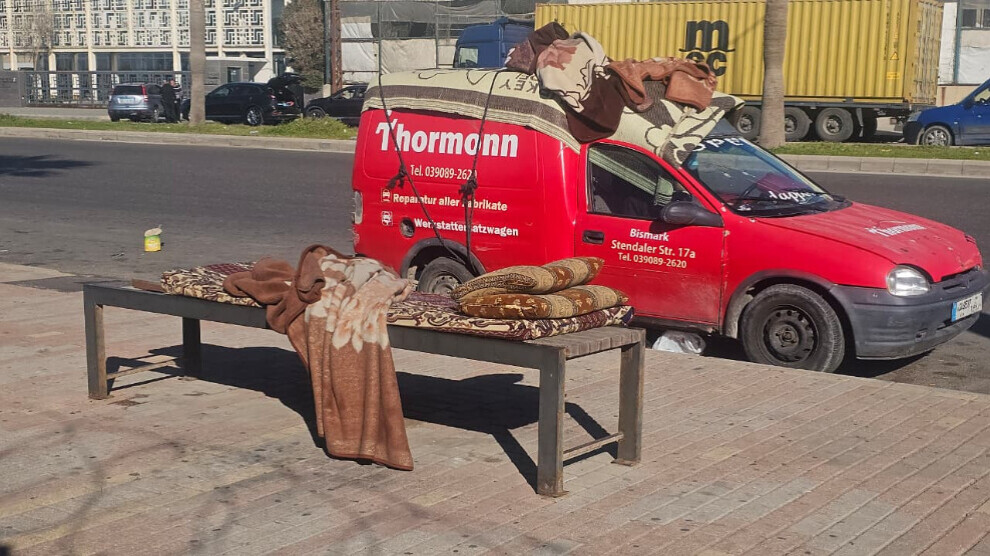
While schools and public facilities are opened to shelter displaced Lebanese, Syrians speak of decisions or instructions that prevent them from being received in these centers, leaving entire families out in the open, without shelter or resources.
Renewed suffering after order to evacuate shelters
In the city of Sidon, Sabuha Mohammad Ali, a Syrian who has lived in Lebanon for nearly two decades, recounts her latest displacement after being asked to leave a shelter where she had hoped to protect her family from the street. She says, “I have been living in Nabatieh since 2006. I built my life in this city, and my three children were all born there. I have nothing left in Syria—I don’t even own a grain of soil there.”
She adds that the war in Syria took the last thing she owned: “My only possession was a house in Syria; I lost it in the war a year and a half ago, and I received no compensation for it.”
For years, she has relied on house cleaning to secure a livelihood for her family. “I work in people’s homes to support my family. My husband is elderly and ill, and I also have a heart condition. I am responsible for him and my three children.” But the recent attacks in the south forced the family to flee Nabatieh: “When the war broke out, we fled to Sidon. We went to a shelter, but unfortunately we Syrians were asked to leave the center.” She asks, “What is our fault as Syrians that we are thrown onto the street without shelter?”
Today, the family finds itself without shelter or means. “I have no request except a roof to shelter me and my family. I have no money for food, nor to manage my family’s affairs.” She explains that her legal status had been stable for years before her circumstances became complicated. “My papers were in order, and I was registered with the United Nations and received health assistance. But after a short visit to Syria that coincided with the entry of the Free Army, I had to leave illegally and return to Lebanon.”
She adds, “Today, I have no contact with the UN, and no one supports us.” She sums up her reality in a few heavy words: “We are today on the street, without shelter or money. Our only fault is that we are Syrian.”
Despite everything, she does not hide her attachment to the place where she lived most of her life: “I lived in this country for 19 years, and I never made a distinction between one sect and another.” She appeals to those who made the decision to reconsider: “They must look at our situation. My country is southern Lebanon, and I would be honored to die there.”
A suspended fate for families on the margins of war
Sabuha Mohammad Ali’s story is just one of thousands. As war rages in southern Lebanon, many Syrians who have resided there for years find themselves outside formal and informal protection networks, amid decisions or practices that prevent their reception in some shelters, giving priority to Lebanese citizens.
While everyone flees the same shelling, the fate of these people remains suspended between a street that does not protect them, displacement centers that do not receive them, and scarce resources that do not secure their survival.
In times of war, nationality sometimes becomes a dividing line between those who find a roof to shelter them and those left to face displacement alone.