
A sculptor turns scrap metal into art that tells a tale of passion and challenge
Eman Ahmed Ali’s journey beğen by chance but a conscious artistic path:discovering sculpture,investing in diverse materials,transforming iron scrap into language of vision,meaning,and innovation.
Eman Samir Ali
Egypt – In the corridors of the Faculty of Fine Arts at Assiut University in Egypt, the name "Chinidi" emerged as a distinctive mark among students of the sculpture department. This name is associated with the teaching assistant Eman Ahmed Ali, who carved her path in the artistic field with passion and determination, even though her beginning was not planned.
Eman Ahmed Ali says that the name "Chinidi" carries a story of ambition and vision. One of her professors gave her this nickname. He saw in her an ambitious personality who loved sculpture and was always present at the faculty. He did not only mean her distinctiveness in the sense of excellence, but he saw that she approached the field with genuine love and passion. He would always tell her that he would derive a name from her family name, and that is how this nickname came about.
She points out that joining the Faculty of Fine Arts was not among her initial ambitions; it happened by chance. However, she soon found herself within this path. She notes that her passion for art was present since childhood. She began her journey with artistic study in middle school, exploring the nature and details of the field. During that period, she noticed her clear inclination towards three‑dimensional works compared to two‑dimensional ones. She was also attracted by the rich diversity of materials in the sculpture department, which combines elements of architecture, painting, and graphics alongside the basic sculptural materials.
She affirms that her connection to tangible work, compared to working on paper, was a main driver for her decision to specialize in sculpture, adding that she began early to explore different materials. "Sculpture is not limited to clay; it includes multiple materials and methods, and the real challenge lies in the ability to employ each material optimally."
She points out that her passion for the field grew over time, intersecting with an old dream she had of manufacturing cars. She had aspired to study mechanical engineering, but family circumstances prevented her from joining the scientific track (mathematics), so she turned to the literary track, holding onto hope that this would open new paths to achieve her ambitions.
Iron scraps turn into an artistic language that expresses the human being
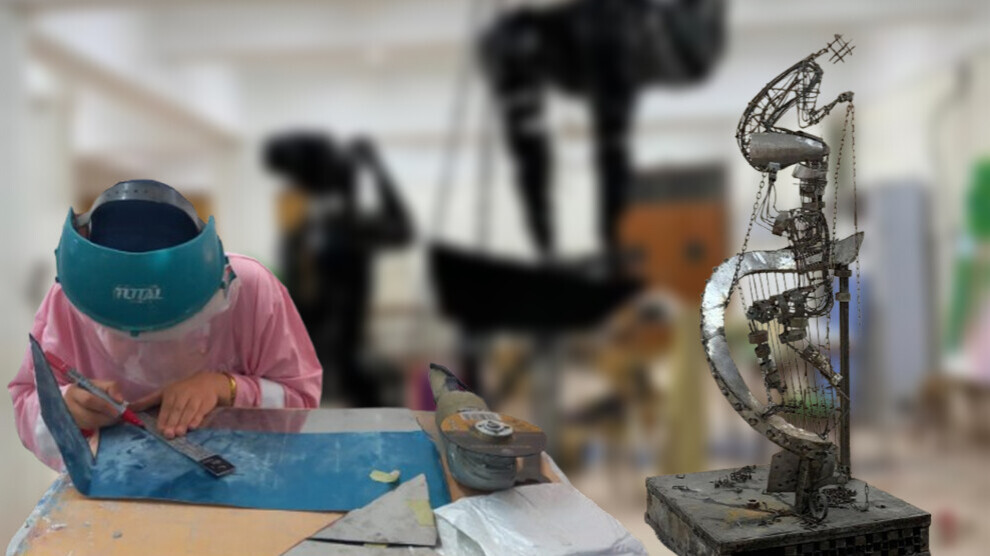
Eman Ahmed Ali explains that her curiosity continued to drive her to discover everything new in materials, until she reached her graduation project. She sought through it to present a distinguished work worthy of the sculpture department. However, the high cost was an obstacle to using traditional materials such as marble and fine wood, pushing her to think of innovative alternatives, most notably recycling using scrap, manufacturing remnants, and iron pieces.
She points out that the idea grew from the materials available in her family's home. Her family, especially her mother, played a great role in supporting her. Her mother believed that recycling could produce works that surpass the original materials in beauty. She adds that she began collecting materials and working on them, abandoning traditional realistic representation and moving toward geometric and free forms that express her own artistic vision.
She notes that her first works in this context were two statues, a man and a woman, using iron to indicate the tensions that may arise between two parties, which end in a state of balance and tranquility. She also added a musical element resembling a harp, to reflect the idea that life is a shared melody between the two parties.
She affirms that the project received academic and professional appreciation, and she was about 85% satisfied with it, despite some observations made by professors. She believes that the graduation project reflects the student's future vision, and that art by nature tolerates multiple interpretations, as each viewer sees the work from a different angle.
An artistic journey exploring materials
Eman Ahmed Ali explains that after her appointment at the faculty, she continued her journey of exploring materials, especially metals such as gold and copper, questioning why only traditional materials like marble, granite, and wood were used. From this starting point, she began working on a scientific research project and focused on one material, eventually settling on stainless steel, and began studying its properties and artistic potential in depth.
She notes that during this phase she reviewed the experiences of artists inside and outside Egypt, and observed diversity in styles between two‑dimensional and three‑dimensional works, along with the use of modern techniques such as cutting, assembly, and argon welding. She affirms that cutting precision and finishing quality are critical factors in the success of an artwork, as any flaw in them may lead to weak cohesion or damage to the work. She notes that some artists rely on executing miniature models before enlarging them using metal materials with high precision.
She reveals her future ambition to execute field works displayed in public spaces and squares, reflecting the cultural identity of the place, especially given that some sites have witnessed the removal of statues. She adds that she seeks to develop her work using modern techniques such as CNC and 3D printing, along with producing artistic pieces that can be used in interior design or as artistic furniture, by integrating stainless steel with other materials such as wood, aiming to present contemporary and innovative works.
On the practical level, she points out that she faced social challenges related to the perception of the nature of heavy work and its suitability for girls, but she believes that will and support are capable of overcoming these challenges. She explains that she made sure to learn from reality by frequenting areas such as Al‑Sabbatiya, dealing directly with iron workshops and scrap, and buying the materials herself, which gave her a rich practical experience.
Eman Ahmed Ali concludes her speech by affirming that this experience, despite its difficulty, was of great value, expressing her confidence that its future results will be more developed and distinguished.