
Conference in Shingal Issues Recommendations for Consolidating Justice and Democratic Integration
Shingal Conference urged genocide recognition, democratic integration, documenting fermans, strengthening Yazidi rights, and protecting Shingal as a living museum to ensure justice.
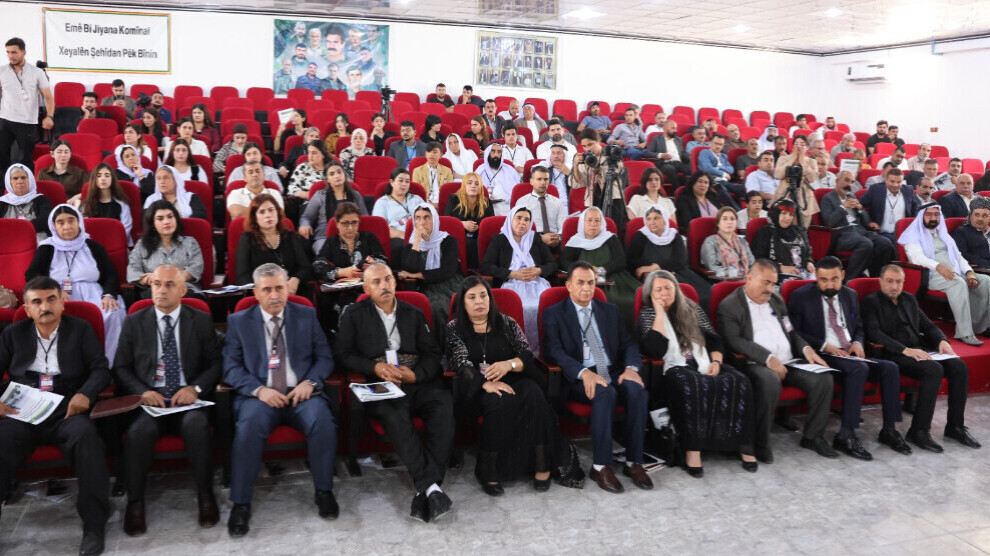
Shingal — The "Genocide and Democratic Integration" Conference, organized by the Abdullah Öcalan Academy of Social Sciences in Shingal under the slogan "Transitional Justice is the Foundation of Democratic Integration," announced its recommendations.
The proceedings of the "Genocide and Democratic Integration" Conference began yesterday, Wednesday, July 15, in the city of Shingal, to examine the repercussions of the genocide suffered by the Yazidi community in 2014, mechanisms for achieving transitional justice, and strengthening Yazidi rights within a vision based on democratic integration and the protection of societal diversity.
The conference's recommendations statement included:
As the Yazidi people, we have been subjected to genocides and successive fermans for thousands of years. To this day, the attacks against us have not stopped. Through these attacks, our geography was torn apart, we were uprooted from our homeland, and countless numbers of our martyrs and missing were created. They sought to erase our language and break our faith. For thousands of years, there have been assaults on our culture and identity. These attacks took multiple forms—some wanted to turn us into their soldiers, some sought to seize our villages and mountains from us, and others attempted to change our beliefs. But the fundamental goal of all these attacks was to eliminate our existence.
Ultimately, the ferman carried out against us on August 3, 2014, was different from all previous fermans. Before the eyes of the entire world, and with the betrayal and complicity of many countries and parties, we were subjected to one of the fiercest attacks that have entered the pages of history. Thousands of children and women were pursued, thousands of people were killed, and hundreds of thousands of our people became displaced. Women and children were sold in markets. Thousands of our martyrs remain in mass graves.
Twelve years have passed since the genocide, but the bodies of our loved ones remain in the earth. Hundreds of thousands of our people remain in camps and in various countries, unable to return to their homeland. No criminal has been held accountable. On the contrary, some of those individuals are still treated as guests around us. Shingal still has no legal status. The children of Shingal who want to protect their people are subjected to attacks from many quarters.
This conference, which was attended by all Yazidi parties within and outside the homeland, and with our friends from Iraq all the way to Europe and other countries, has shown that the will of the Yazidis and their allies has been placed on the path to a solution. Through this conference, we want to extend a call to all concerned parties to rise to their responsibilities to heal our wounds.
First, the Iraqi state and all countries must recognize the genocide and enact a special law on genocide. Our will, identity, and belief must also be accepted, because today we want to secure our rights firmly through democratic integration. Just as this Yazidi community sees the Iraqi state as a state with its own entity, the Iraqi state must also see this community without discrimination, as an essential part of its structure.
Expanding the Scope of Struggle and Organization
Also at this conference, the importance of Yazidi unity and organization to prevent new massacres was discussed, and important decisions were made for the coming stages. In particular, to enact a genocide law both domestically and internationally, a decision was made to expand the struggle and organization.
It was also discussed how the Yazidi community can protect its existence, culture, and belief through democratic integration, according to the solution project presented by leader Abdullah Öcalan for the Middle East's renaissance. A decision was made to engage in this path.
According to the laws that provide a ground for a solution, the Yazidi community must establish mechanisms capable of devising a plan for democratic integration—not a policy that leaves matters suspended, but a democratic integration that is consistent with itself and based on understanding.
On this basis, important decisions were taken at the conference, and from now on, work will be carried out to implement them, so that the Yazidi community itself determines its own path of solution. This includes: adopting this conference as the first genocide conference, to be continued in the coming years; establishing a special institution for genocide awareness; working to collect the ferman archive, which remains inaccessible to the Yazidi community, and documenting and organizing it; and to ensure that the effects of the ferman are not forgotten, Shingal must be preserved as a "living museum." Coordination and relations with all concerned parties must be strengthened for the sake of rebuilding Shingal.
The conference also stressed the need to intensify work to guarantee the rights of the Yazidi community and build democratic integration, as well as to continue efforts to raise awareness about the genocide in all international forums.