
Women of Amed: No Justice Without Holding Perpetrators Accountable and Revealing the Truth of Femicide Crimes
Amid escalating femicide and impunity in Turkey, amed women launched ten weeks of Tuesday Protests under “Justice and Memory,” demanding perpetrator accountability and women’s protection and right to life.
ARJIN DILEK ÜUNCEL
AMED_Escalating violence against women and femicide crimes, as one of the results of gender inequality, remain an intractable problem in Turkey. With the beginning of each new day, we wake up to news of femicide crimes in different cities of the country, while women are left in a whirlpool of violence due ot impunity policies.
At least 27 women were killed during last September by men, who also injured at last 52 Women, harassed 28 women, and forced 26 women intoprostitution. Likewise, 222 women were killed during the first eight months fo 2026. As fort he period extending from 1 to 2 October only 8 women were killed.
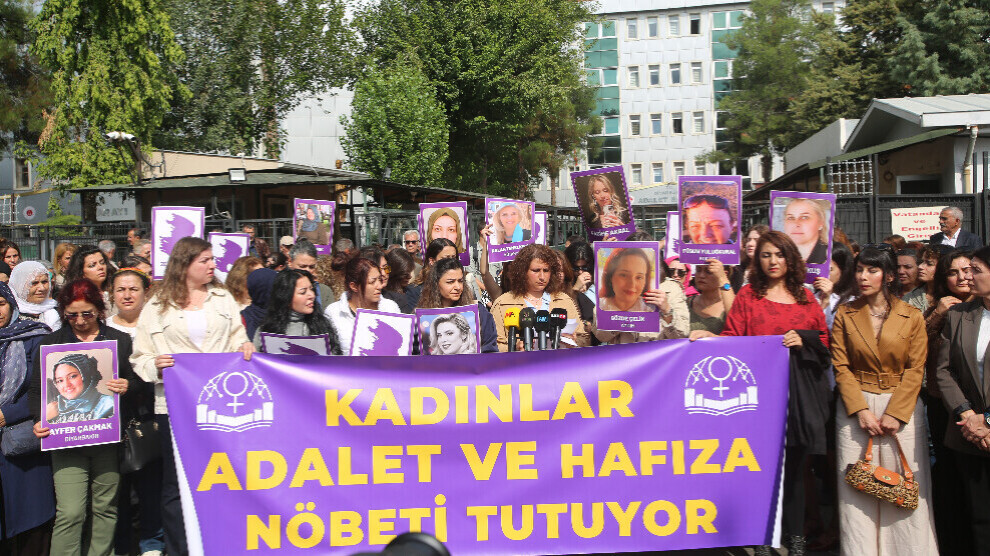
In the face of this reality, women did not remain silent, but launched in Amed (Diyarbakir) in northern Kurdistan, on 6 October, a protest stand under the title “Women’s Stand for Justice and Memory,” rejecting femicide crimes, violence, and impunity policies.
The stand continues for ten weeks, on every Tuesday of each week, at 12:30 pm in front of the Diyarbakir courthouse. This stand is organized by the Amed Network Against Violence, with the participation of activists, human rights defenders, human rights and feminist organizations, alongside democratic local administrations. The participants demand an end to impunity policies, stressing that commemorating the women who were killed should not be limited to the circumstances of their deaths, but should include their names, lives,and stories.
During their weekly stand, the women confirm that they “recall that women are not just numbers in judicial files, or headlines in newspapers, or statistics. Memory is not limited to evoking the past, but also represents a means of defending women’s right to life, opposing gender inequality, and confronting all structures that fuel violence against women.”
The paticipants stress that the justice they seek should not be limited to issuing rulings after femicide crimes occur, but should begin with protecting women and guaranteeing their safety and their right to life.
“The Women of Amed Must Come and Participate in the Protest Stand”
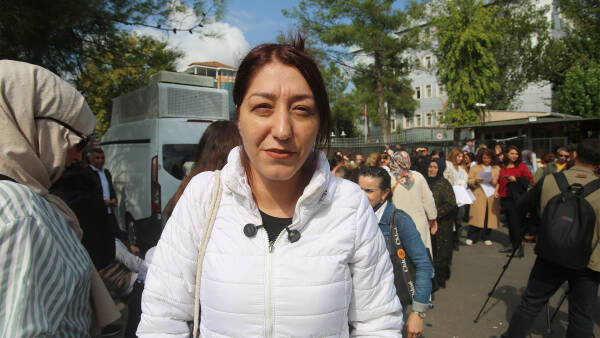
Activist in the Free Women's Movement (TJA), Tulin Aydash, said: "Factors such as special war policies and the dominant patriarchal mentality lead to confining women inside the home and separating them from life."
She explained that the goal of the stand is to shed light on the policies that prepare the ground for femicide crimes, adding: "We have prepared a movement plan extending for ten weeks. We will continue to raise our voices, demanding an end to femicide crimes."
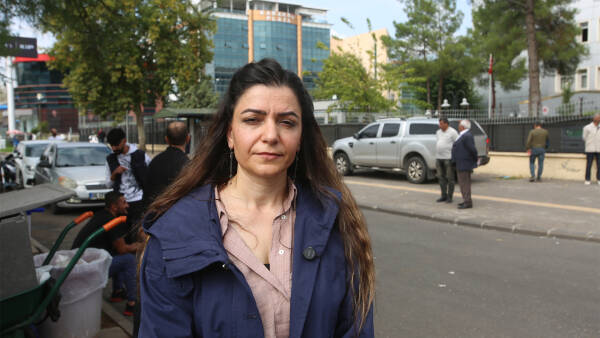
For her part, Bahar Bakr, an activist in the Free Women's Movement, said: "We do not want another woman to be snatched from life, and we do not want another child to be deprived of their mother." Feministd: "We have launched a joint protest stand in cooperation with all feminist institutions. The loss of eight women's lives and their killing within one week constitutes a great psychological shock for the women who remain alive. We demand the punishment of the perpetrators in order to reduce these crimes."
"Women Want to Turn Their Demands into a Societal Issue"
For her part, Aycan Deryl, a member of the Women's Committee in the Amed branch of the Association of Lawyers for Freedom (ÖHD), explained that women want, through the protest stand, to raise their demands for justice not only within the corridors of courts, but in all areas of societal life, stressing the necessity of turning women's demands for freedom and rights into a societal issue.
She added: "When comparing the situation with the results of hot wars and conflicts, we notice in the recent phase that the number of women and girls who are systematically killed as a result of violence has increased. The increase in femicide crimes and suspicious deaths has become a phenomenon that is difficult to contain."
She noted that state institutions that are supposed to establish policies to confront this problem, the patriarchal judicial mechanisms subject to male dominance, and the practices of authority, continue to cover up the massacres committed by men, keep suspicious deaths in a circle of ambiguity, and reproduce gender-based discrimination, instead of revealing the circumstances of the killings.
"Our First Demand Is Justice"
Aycan Deryl said that "our first demand is justice," noting that factors such as reducing sentences under the pretext of provocation, reducing penalties on the grounds of good behavior, and not conducting trials effectively, contribute to the continuation of dominant patriarchal practices, and hinder revealing the truth and achieving justice.
She added: "When we look at the data of the last six to eight months, we find that cases of suspicious death of women have exceeded the number of their killings. This shows us that the patriarchal state mentality, instead of revealing the truth of the deaths, closes the files without considering the possibilities of killing, under pretexts such as suicide or falling from a high place."
She noted that they try every week to preserve in their memory the names of the women who were killed and the stories of their lives. "We are talking here about the files of these women, and about building a feminist discourse and a demand for justice in the face of gender inequality and the practices of authority."
"Why Is No Light Shed on Our Simplest Demands?"
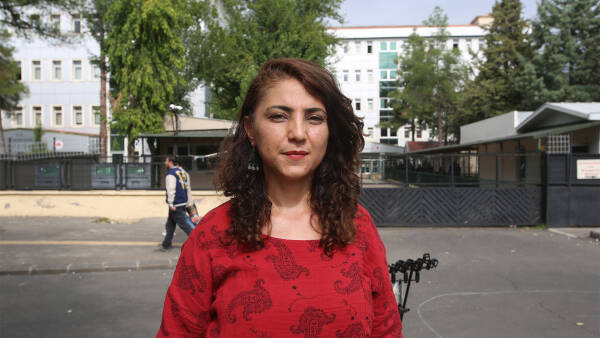
Aycan Deryl confirmed that they will continue to express their demands in front of the Diyarbakır courthouse every Tuesday, asking: "Why are women killed and violence practiced against them? Why do our simplest demands, represented in gender equality and freedom, not receive sufficient attention? And why are no real efforts made to build a society based on these principles?"
She noted that the dominant patriarchal system and those who entrench it are the ones concerned with answering these questions, not women, who are aware of the societal values rooted in their history. She confirmed: "We will continue our movement to re-highlight women's demands for justice, at the judicial and societal levels, and to emphasize the necessity of conducting effective investigations into the crimes committed against them."