
Women in Van Call for Societal Struggle Against Rising Drug Abuse Among Youth
Women in Van (Wan), North Kurdistan, have called for strengthening community resistance against the spread of drug abuse, particularly among young women and men, urging awareness and rehabilitation efforts.
MEMEHAN HELBIN ZEYDAN
Van_ Drug abuse is spreading across cities in North Kurdistan, particularly among young women and men, because of “special war” policies alongside social and economic problems.
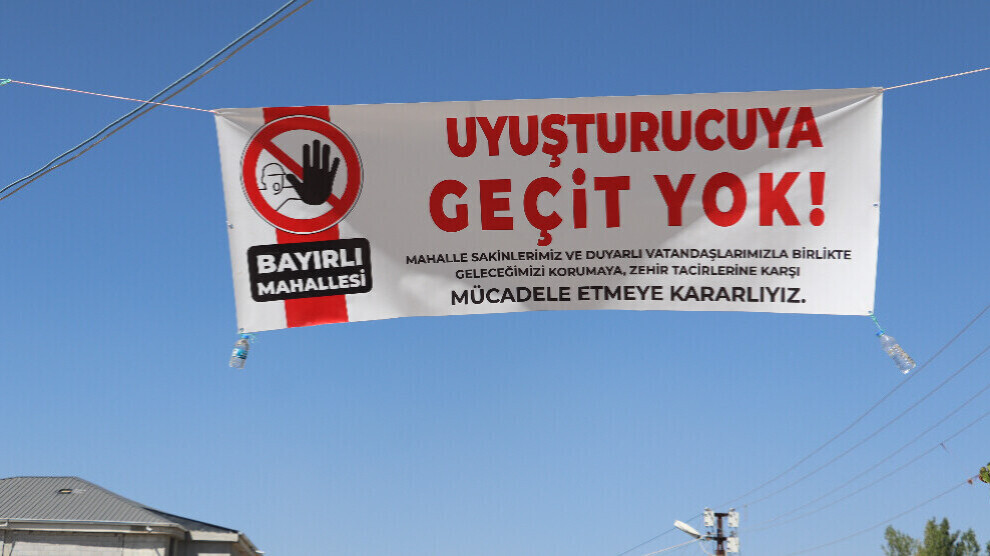
The “Şıyar Be” platform, which operates in several cities of North Kurdistan and works to combat addiction, continues its field activities and awareness-raising efforts, as part of the “Rise Up” campaign it recently launched.
Arifa Shukur, a member of the Riya Armuş Municipality, explained that they are committed to carrying out activities, particularly in neighborhoods described as “bling sports.” She affirmed: “We will continue our work to increase these activities with the aim of reducing drugs and prostitution.”
Young Women Are Targeted
Leyla Çelik, a member of the Tuşba Municipality Council, also stated that drugs are the most widespread tool of special war. "Drug use has spread significantly, especially among teenagers, and the goal is to completely separate young people—especially young women—from society."
She believes that the state does not develop a serious policy to confront drug sales, but rather, as she says, "applies a policy of complete impunity. Unfortunately, there are no deterrent penalties for the sale or use of narcotics, and the state does not even prevent them either."
She added: "When we look at it from a social perspective, it leads to a completely fragmented society. To combat this, more activities must be organized for young people, encouraging them to socialize, come together, and organize among themselves. We will begin the process of rebuilding from within ourselves, and advance with the goal of eliminating these special war policies."
Leyla Çelik also referred to the recent campaign launched by the "Be Vigilant" platform. "There have been positive and serious responses from young women and men in all neighborhoods regarding drugs. We do not want drug use or sales in our neighborhoods, streets, and homes. We want to come together and take an organized stance in this area as healthy individuals."
Medya Mermit, a member of the Edremit Municipality Council, affirmed that the increase in drug abuse in North Kurdistan is a result of special war policies. “We will not allow drugs to spread in Kurdistan, and we will not allow the tools to special war_praticed through addiction and targeting young women and men_to pass. We will continue our work in this regard, and our struggle and work against the policies being waged against us will continue as well.”
What is the Responsibility of the Municipalities?
Regarding the efforts to combat drugs, Yıldız Tuncer, a member of the Riya Armuş Municipality Council, noted that they organize various anti-drug events and work to bring young people together. "We try, as much as we can, to focus our cultural activities directed at young people within the framework of combating addiction. We bring our youth and our people together in confronting special war policies. In this regard, as municipalities, we try to do everything within our responsibility in confronting these policies."
She added: "Drugs are a major problem throughout Turkey, but they have begun to spread more widely, especially in the cities of North Kurdistan. We, as municipalities affiliated with the Peoples' Equality and Democracy Party (DEM Parti), will focus on the necessary work in this area, and we will continue our struggle against addiction."
Resolving the Conflict Stage on the Part of the State
Ayten Kıran, Co-Chair of the Van branch of the Human Rights Association (İHD), explained that the association is a member of the "Be Vigilant" platform, considering that institutions are still insufficient in this field.
She believes that it is necessary to carry out highly professional work. "Since the platform is still relatively new, more serious steps can be taken regarding it in the coming period. During periods of conflict, drugs were spread among Kurdish youth as part of special war policies."
She focused on the sensitivity of the current phase, saying: "From now on, we must be more vigilant. When a young person or child cannot find money to buy drugs, they may resort to theft or robbery. When a woman cannot obtain drugs, she may be pushed into prostitution. An adult may resort to theft to get money for drugs, or may develop motives to commit murder for various reasons, killing his wife and children."
She affirmed: "In this phase, we are witnessing the severe damage drugs are causing in Kurdish cities. These activities often take place in front of schools. Therefore, the platform should cooperate with various institutions and work to confront this phenomenon."
The Necessity of Intensifying Awareness Efforts
Ayten Kıran also pointed to the need to intensify awareness work, affirming that the greatest shortcoming lies in the absence of rehabilitation centers. "We do not have rehabilitation centers. After identifying these young people, how will we provide them with treatment? When they are taken to hospitals and admitted, they are discharged after 21 days on the pretext that 'their blood is clean.' Under this system, the probability of their return to addiction is close to 100%, and there are many cases we witness around us."
Therefore, as she says, first and foremost, "all platforms and civil society organizations must unite, in cooperation with municipalities, and if necessary with state institutions as well, to open good rehabilitation centers. After 21 days, these young people should participate in various activities and different kinds of work there, and we should help them move completely away from that stage. Unfortunately, no such possibility exists at present."
In concluding her remarks, Ayten Kıran emphasized the need for civil society organizations to assume their responsibility. "I hope that from now on we will do what falls upon us. But in this phase, we, as civil society organizations, must also review our performance and criticize ourselves. We have not been sufficiently responsible. Merely diagnosing the problem is not enough; we must also find a solution for it."