
What Are the Motives and Possible Parties Behind the Attacks in Hasakah?_Analysis
The plots in Hasakah governorate were thwarted thanks to the rational positions of the Kurds and indigenous Arabs, who faced incitement with restraint and a democratic stance, and prevented provocations from achieving their goals.
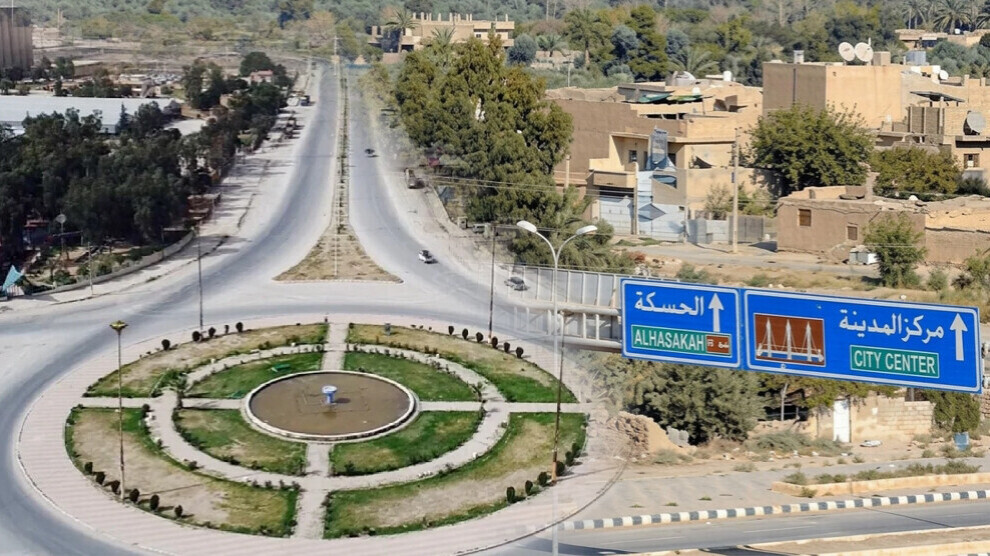
ROJBIN DENIZ
NEWS CENTER_ During the pest days, anonymous digital accounts called for a demonstration in Hasakah against the Syrian Democratic Forces (SDF) and the Kurds following Friday prayers on 2 October.Then newly created accounts appeared publishing uniform content inciting against the gains of the Kurds in Hasakah and Rojava.
Following the first call, on Friday, 2 October, a demonstration was organized in the Ghweiran and Nashwa neighborhoods in Hasakah governorate.
The "Ghweiran" neighborhood is named after the Ghweiran tribe. During the past fifteen years, this neighborhood was among the neighborhoods that provided effective support to ISIS. However, there are also many residents of Ghweiran who joined the SDF and the Asayish forces, as well as others working in the institutions and bodies of the Autonomous Administration. The neighborhood also offered martyrs during the revolution's journey.
The neighborhood has witnessed partial change during the past fifteen years. Despite the division and divergence of political positions within it, there is a category that has chosen to adopt a balanced position. This category does not tend toward sharp rupture with the Kurds, and includes people who believe that coexistence and brotherhood between the governorate's components, which has continued for centuries, is the way to achieve stability and peace. This category did not participate in the recent demonstration; rather, groups brought in from outside and incited came out in it.
Given the limited numbers of participants, and that their anger appeared somewhat manufactured and fabricated, the demonstration that reached "Al-Salam" Square did not continue, as the participants dispersed within an hour or two.
The Asayish forces were aware of the organizational movements taking place through digital media accounts. In return, the internal security forces and special forces took important security measures. In sum, the attempts that took place failed and did not achieve their desired results.
Claims About Holding Secret Meetings
Perhaps the failure of these attempts to achieve results angered some parties, and therefore this time claims were circulated through digital social media accounts, stating that elements of Hay'at Tahrir al-Sham, who had previously come to the region, held secret meetings with tribes and Arab groups, and that Ahmed Al-Hilali was among the alleged participants in these meetings.
The same accounts continued their posts and incitement calls, targeting reaching broader segments of Arabs. The calls urged them to control Hasakah on Friday, 9 October. It was clear that there was a policy being activated aimed at entrenching a perception that the survival of Hasakah governorate under Kurdish control constitutes an insult to Arabs and a diminishment of their dignity.
In return, the position of the Arabs residing in Hasakah did not change. Only a limited category responded to the calls, announcing its readiness to participate in the demonstration. With the low level of participation from Hasakah itself, and the limited feelings of anger toward the Kurds, additional plans were activated.
Groups linked to ISIS were transferred to Hasakah from Al-Shaddadi, Tal Brak, Tal Hamis, Deir ez-Zor, and Raqqa, areas known for the presence of persons with hostile positions toward the Kurds and active participation in ISIS ranks. These groups were transferred under the protection of police groups affiliated with Hay'at Tahrir al-Sham.
These were elements of armed groups linked to ISIS, the Nusra Front, and Al-Qaeda, who had until now remained hidden in the region in one way or another.
Their Goal Was to Ignite a Kurdish-Arab War
The plan was as before: organizing a demonstration after Friday prayers, attacking neighborhoods with Kurdish population density, looting, stealing, and burning homes, shops, and cars belonging to Kurds, as well as targeting Kurdish symbols. Alongside that, free rein was given to discharge all feelings of anger and hatred toward the symbols of resistance and women's heroism. According to the plan, everything was based on provoking the Kurds and dragging them into war. The goal was to ignite a Kurdish-Arab war by luring the Kurds into confrontation, and then controlling all Kurdish areas, foremost among them Hasakah.
In the news circulating from Damascus, a similar discourse was also promoted. Media outlets and digital accounts began publishing claims that residents are expressing their objections, demanding the activation of government institutions, and that Arabs constitute the population majority, and therefore demand granting Hasakah governorate to the Arabs.
But what happened in Hasakah on Friday was not behind the people. Rather, the Arabs residing in Hasakah say: "These do not represent us. We accept living with the Kurds. Do not sow discord between us." They are also angry with the Ghweiran neighborhood, because of what they see as its role in preparing the conditions that led to these events.
During the attacks, there were armed groups that wanted to attack the Kurds amid takbir slogans, raising ISIS slogans and posters of Saddam Hussein. It was a planned and organized attack attempt, directly targeting the gains of the Kurds and women. As they advanced toward the inner neighborhoods of Hasakah, they attacked women's symbols and signs written in the Kurmanji language.
Escalating Anger Toward Women's Gains
The reactions of women and the Kurdish people are known, especially after ISIS, which had previously cut off the braid of a female fighter, revealed through digital social media its practices against women. The act of an ISIS element cutting off a Kurdish woman's braid and parading it in his hand sparked a wave of overwhelming anger. The people could not accept that. These reactions turned into a wide campaign that brought together women from various categories.
That image, which clearly expresses what the ISIS mentality wants to do with women, revealed how the concept of the women's revolution in Rojava, and the revolution embodied on the ground based on this concept, placed various forces, foremost among them ISIS, in a difficult confrontation. These forces did not expect a reaction of this size and effectiveness.
It is known to everyone that the political forces that underestimated women's anger face a state of blockage and disintegration in Damascus. The attack by armed groups during Friday's attacks on the banner showing a woman's braid cannot be dealt with as a passing incident or a normal matter. Behind the anger directed against women and the Kurdish gains that developed under women's leadership stand political calculations of internal and external forces in Syria.
Building a political entity and a state structure that reject women is naturally formed on the basis of anger at women's gains. They are today seeking to build the new Syria on walls of anger and hostility toward women's gains.
The Significance of Al-Shaibani's Visit to Ankara
Who benefits most from these calculations? The Damascus administration appears to adopt a divided position on this issue. Data indicate a divergence between Ahmed Al-Sharaa and Asaad Al-Shaibani, whether at the political level or regarding regional interests. The party most seeking to extend its influence over Kurdish areas appears to be Al-Shaibani's group.
Al-Shaibani's name stands out particularly because of his closeness to Turkish Foreign Minister Hakan Fidan. Indeed, the number of meetings between Al-Shaibani and Hakan Fidan since the formation of the new Syria almost seems limitless. There are weekly meetings and gatherings held in the format of submitting reports and briefings.
When the events began in Hasakah, Al-Shaibani was in Ankara. I do not believe that was a mere coincidence. When Hasakah governorate was on the brink of war, the connection of Al-Shaibani's rapid travel to Ankara with what happened will become clearer soon.
As for Ahmed Al-Hilali, whom we see more present in the field, he is considered the right-hand man of Al-Shaibani, who seeks to influence the Kurds by speaking in the Kurmanji language. It is no coincidence that we see Al-Hilali frequently in media outlets affiliated with the Kurdistan Democratic Party, as he appears in them before and after every event. His relations with the Kurdish National Council in Syria are also good.
There are assessments that these persons are the ones behind inciting Kurdish youth through the Kurdish National Council and pushing them to take to the streets. This is information, according to the text, obtained directly from the field, and conveyed by reliable sources.
On the other hand, Al-Hilali appears to be following a policy aimed at marginalizing the role of the governor and making the Arabs the dominant party in the face of the Kurds; or in other words, repeating what the Baath regime did.
Among the news also circulated is that Al-Hilali is seeking, during this phase, to organize behind-the-scenes meetings with Arab tribes to win them over to his side. Thus, these, according to what the text proposes, constitute the party seeking to destabilize Hasakah and ignite a Kurdish-Arab war.
What Stands Behind the Unrest in Hasakah?
In contrast, there are figures known for their closeness to Marwan Al-Ali and Al-Julani who do not hide their anger toward the Kurds. But they realize that a war of this kind will harm Syria more than it will harm the Kurds. Therefore, they stand in the face of the groups seeking to push the region toward instability.
Al-Julani's goal of making Syria a potential alternative to the Strait of Hormuz, and turning it into a trade corridor, directly intersects with this issue. The M4 trade route passes through Kurdish areas. Reactivating this route, alongside restarting the oil pipeline extending toward Baniyas in southern Syria, would remove Turkey from the regional trade circle. Thus, the Turkish coasts may lose their status as the first option for regional trade. This is a new development that would also affect the Kurdistan Democratic Party.
Consequently, Syria's stability affects Turkey directly. But Turkey, according to what the text proposes, is working through Al-Shaibani to fuel chaos in Syria and create an atmosphere of violence and crises. This is one of the dimensions of Turkey's support for this plan.
As for the other dimension, it is that the peace and democratic society process ongoing in Turkey has reached a stage based on making legal amendments and taking tangible practical steps in this direction.
While peace between the Kurds and Turks will benefit both parties, meaning the Kurds and the Turkish people together. But the political mentality that moves according to external calculations, and seeks to keep the Kurdish-Arab and Kurdish-Turkish wars burning, draws its strength and interests from the continuation of the conflict.
These parties were not supportive of the PKK resolving for itself, nor did they support the integration of Rojava within Syria. Rather, they were the party that ignited the fire and kept pouring gasoline on it, with the aim of eliminating the Kurds' gains.
Leader Abdullah Öcalan described this situation with the term "the state outside the standards." This situation appears to constitute one of the dimensions of the war that Turkey seeks to ignite through Hasakah.
There is a final point that must be added to that:
The withdrawal of the United States from the Kurdistan Region created a new regional reality for the Kurds. This reality revolves around the division of the Kurds and their inability to anchor their future to their own will and their own forces.
When we look at the results of this division, we find that the survival of the Kurds without protection, and the difficulties they may face in directing their forces toward the appropriate positions, carry the risk of inflicting great losses on the Kurdish people.
The parties that see the Kurds as weak under this situation launch attacks on them in Hasakah and Kirkuk, using the ISIS card as a means of pressure and threat. In other words, they seek to weaken the Kurds and break their confidence in their own forces.
In return, if the Kurds are able to achieve unity and solidarity and adopt the concept of joint defense, they will be able to respond effectively to their enemies, whether in Hasakah or Kirkuk.
Wisdom and Restraint Prevailed in the City
In sum, the plot engineered through Hasakah was thwarted thanks to the rational positions taken by the Kurdish people and the indigenous Arabs in Hasakah. The democratic position of the Kurdish people and their disciplined behavior demonstrated, once again, their ability to confront incitement, and did not allow provocations to pass and achieve their goals.
As for the Kurdish youth who defended Hasakah, they defended their people with great dedication and immense sacrifices. This position also thwarted the propaganda promoted by Kurdish nationalists, which claims that the Kurdish defense units that engaged in the integration process have lost their ability to protect the people. The city's residents were defended with a high spirit of wisdom and restraint.
What remains now is to examine the behind-the-scenes of what happened, and to understand the escalating anger among women toward the armed formations, as well as the Kurdish people's insistence and firm determination to protect and defend their gains.