
Weapon Destruction in Jasna Cave... Messages of Peace Through the Eyes of Witnesses
The Kurdish people have long struggled for peace, but were forced at times of attack to bear arms in defense of their land. Ultimately, at the initiative of leader Abdullah Öcalan, they destroyed their weapons as a symbol of the pursuit of peace.
HELEN AHMAD
Sulaymaniyah — Throughout history, Jasna Cave was not merely a geographical location. At one stage, it became a place from which the voice of rights advocacy rose, and at another, it became the stage for a significant event in contemporary history.
Some places are not merely land; they carry the memory and history of peoples. Jasna Cave is one such site that witnessed two prominent events in Kurdistan's history within a single century. At the beginning of the last century, Sheikh Mahmoud Al-Hafid published from this place an issue of the newspaper "Nida al-Haq" (Call of Truth), which became a voice for national demands and consciousness. Nearly a century later, on July 11, 2025, Jasna Cave returned to the forefront of events when a ceremony was held there for the destruction of weapons by a group of fighters from the Kurdistan Workers' Party (PKK), within the framework of the peace and democratic society process initiated by leader Abdullah Öcalan.
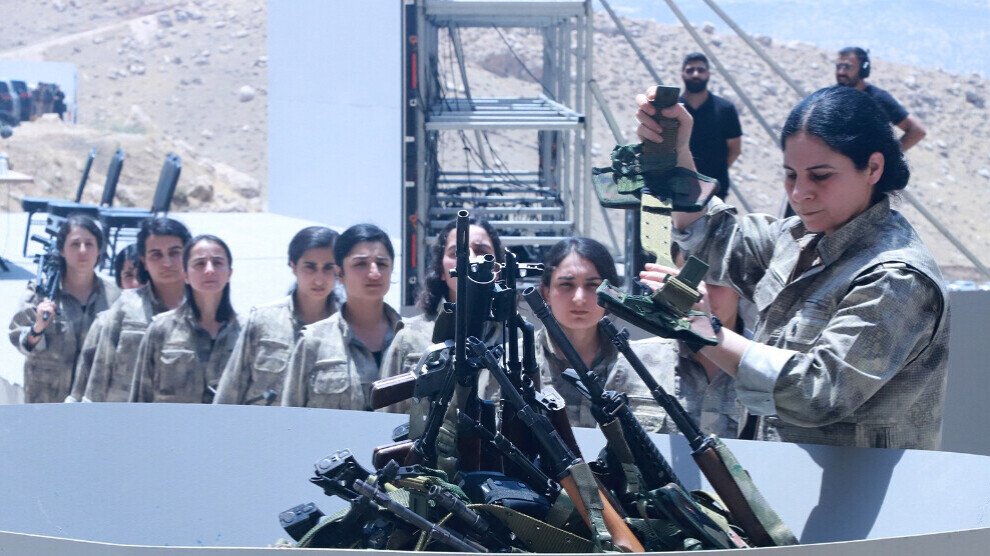
On that day, a number of politicians, journalists, and observers attended, and 30 fighters (15 women and 15 men) entered the ceremony site in coordinated formation. After a message was read, the weapons were destroyed, and the fighters then left the site.
Testimony from Inside the Weapon Destruction Ceremony at Jasna Cave
Journalist Tawar Adel, from the city of Sulaymaniyah in the Kurdistan Region, who witnessed and conveyed the event, described the weapon destruction process as a clear political message reflecting the party's readiness to seriously engage in the peace process, affirming that the initiative carried profound implications at the political level.
She said: "We witnessed a historic event for the Kurdish people. Through our media work, we followed and covered the weapon-burning process carried out by the fighters, in a scene embodying the transition toward a new phase."
She added that the peace initiative put forward by leader Abdullah Öcalan succeeded in attracting various powers and political parties, even bringing together opponents of the Kurdish people in one place—a step that reflected the importance of dialogue and the possibility of opening a new page based on political solutions.
Recalling, as one of the journalists who covered the weapon destruction ceremony on July 11, 2025, the atmosphere before the event, she noted that all attendees—citizens, political activists, Mothers of Peace from northern Kurdistan, along with political observers and representatives of Turkish intelligence—were awaiting the start of the ceremony without knowing what would take place. She added that shortly before it began, everyone was told not to raise slogans or make statements. However, the supporters of the Freedom Movement and the Mothers of Peace, upon the fighters' appearance, stood chanting "Long live leader Abdullah Öcalan."
Despite attempts by observers to signal for silence, the attendees—with eyes full of tears and emotions mixed with joy and sorrow—received the scene with applause and cheers. Afterward, the weapon destruction and the message of the event were announced, and groups of fighters, led by Bese Hozat, came forward and destroyed their weapons. After the ceremony ended, the fighters returned to the depths of the mountains.
The Impact of the Fighters' Appearance Led by Bese Hozat
The appearance of Bese Hozat and a group of leader Abdullah Öcalan's comrades during the ceremony was a major shock to Turkish observers and Turkish intelligence agencies, according to Tawar Adel. "The group's appearance led by Bese Hozat was unexpected. Turkish authorities and many observers had spoken of the possibility of weapons being handed over under US supervision, with weapons codes being received and then handed over. But the fighters chose to burn their weapons."
She added: "The message of descending to the arena, burning weapons, and lighting fire carries for the Kurdish people the meaning of renewal and strength. Moreover, their return to the mountains afterward astonished the attendees and the world." She explained that the Kurdish people, throughout their history, were forced at many stages to ally with major powers or various parties to protect themselves, but they considered that the freedom fighters, by destroying their weapons, sent a message that they seek no one's protection but rely on their own struggle.
She also noted that Western countries moved after the ceremony, calling on the Turkish government to implement the peace process and demanding the opening of a path related to leader Abdullah Öcalan's rights. "We also have the Yazidi people, thousands of whose sons were massacred. But with the peace issue today, there is hope for an end to massacres and for peoples to live together. This in itself carries great resonance and impact."
Weapon Destruction... Another Message in the Peace Process
Continuing her remarks, journalist Tawar Adel said that the freedom fighters' withdrawal from the media scene after the weapon destruction ceremony carries another message within the peace process. "The withdrawal from the spotlight aims to avoid turning the event into propaganda material." She explained that "the fighters' withdrawal from media coverage is the second or additional message of the peace process. This action confirms that the Kurdish people and the fighters want to reach peace and coexistence." She noted that the Freedom Movement continues to appear in the media speaking about the peace process, supporting leader Abdullah Öcalan, and expressing readiness for any decision serving the interests of the region's peoples.
The continued consolidation of the peace process has resonance and impact, as our interlocutor affirms. This process is not a path that lasts a day or two and then is declared an achievement. "The peace process is a long process of struggle and continuous work for the Kurdish people." She added that people await daily the issuance of necessary laws from the Turkish parliament, the implementation of steps related to rights, the release of detainees in northern Kurdistan, and the end of the isolation imposed on leader Öcalan.
She believes that the difficulties faced by the freedom fighters prove that the issue of peace and reaching it "is not easy," as it began through a long struggle and sacrifices for the rights of an entire people.
Tawar Adel spoke about her feelings as a journalist while covering the weapon destruction ceremony. "Previous generations always speak about their historical events, while we felt we had no major event to speak of. But we saw the wheel of Kurdish history turning once again—this time through the issue of peace and coexistence among peoples. We have become witnesses to a historic event that will be spoken of for the next hundred years."
She considered what happened an achievement. "Today we speak of the achievements of the Kurdish people. This was, for me and for all those present, a special feeling. It was the first time we saw a group of fighters up close, with the weapons they had carried for years, with which they had participated in many battles and maintained on their shoulders."
An Important Step Toward Consolidating Peace
Journalist Shoukhan Mirza was also present at the weapon destruction ceremony. She recalls for our agency the circumstances that led to that decision, saying that leader Abdullah Öcalan's call on February 27 included a decision to hold a congress of the Kurdistan Workers' Party. Following that, the Freedom Movement took the necessary steps to show goodwill for the success of the peace process.
She recalled the day she was invited for media coverage: "On July 11, an invitation was extended to the media to cover a historic step the Kurdistan Freedom Movement would take. The place and time were not specified at that time. We at Azadi Media were told to prepare to go to the location and cover this important step live."
The invitation came after a long period of tensions and attacks suffered by the Kurdish people from the Turkish state, opened the door for discussions, and, as she says, strengthened some diplomatic relations at that stage, representing an important step for political parties in the Kurdistan Region and within Turkey.
She continued: "A large number of journalists from different countries were present. There was only an invitation for media professionals to attend, with no details or precise information about what would happen. So we were left to our curiosity, especially after the failure of the peace process in 2013. The whole world was waiting to see what step the Kurdistan Freedom Movement would take to show its goodwill."
She noted that the first step of the process began in Sulaymaniyah, where preparations were made to announce a statement on weapon destruction, but the location later changed—a development that drew attention. She explained that the reason was related to the security situation in the area.
She added: "The ceremony was held at Jasna Cave, where Bese Hozat, Co-chair of the Executive Council of the Kurdistan Communities Union, led the ceremony with a group of 30 fighters. There, the practical steps began in a scene that marked a historic milestone in the Freedom Movement's path." She noted that the ceremony was accompanied by anticipation and questions about the weapon destruction mechanism. The Freedom Movement clarified that the step was to demonstrate goodwill toward the peace process, affirming the continuation of its struggle through political, diplomatic, social, and intellectual means.
Jasna Cave... A Peaceful Refuge for Guerrilla Fighters
Shoukhan Mirza said that the choice of Jasna Cave holds great geographical and historical significance, as this place had a special role in the history of the freedom struggle in the Kurdistan Region. The first Kurdish newspaper was also published there, giving it distinctive historical value. "Kurdistan freedom fighters carried out their struggle in caves for many years. The fighters' emergence from the cave is a clear message that the intention of the guerrilla movement and the Kurdistan Freedom Movement is to transfer the struggle from the mountains to the cities and enter a new phase of diplomatic and political work."
She explained that the scene in which a number of fighters, led by Bese Hozat, descended from the cave carries important connotations. "A woman leading this process carries a message that women can be at the forefront of the peace and democracy path advocated by leader Öcalan. It also sends a message to the world that the Kurdish people want an end to the years of violence and war between the Kurdish people and the Turkish state, and that the struggle should continue through dialogue and political work."
A Step Toward Consolidating Peace and Democracy
Journalist Shoukhan Mirza explained that the Kurdish people want their political identity to be recognized, their constitutional and cultural rights to be established in the laws of the countries that divided Kurdistan, and for the Kurdish people to have a political framework that expresses their existence.
She noted that Bese Hozat's leadership of the process had global resonance. "Women possess a strong will and resilience like mountains, and she made an important decision in this path." She noted that the fighters' readiness for this step was not easy, as destroying weapons they had carried for years was a difficult decision. The true background of this struggle, she said, lies in the intellectual, political, and social work carried out by the movement. "The Kurdistan Freedom Movement does not rely only on armed struggle; it is a political, intellectual, and social movement with multiple dimensions within the framework of the Kurdish freedom struggle."
Divergent Interpretations of the Weapon Destruction Message
She criticized some media outlets affiliated with authorities in the Kurdistan Region, considering that they dealt irresponsibly with the Kurdish issue and presented the matter as if the movement had ended after 50 years of struggle and handed over its weapons to the Turkish state. "Some people saw this step as an important opportunity to see what step the Turkish state would take in return."
She also said that the Kurdistan Freedom Movement recognizes that the Turkish state has historically been built on policies aimed at denying Kurds and other peoples within Turkey. Today, the movement and leader Öcalan want to change that and build a democratic republic in which all peoples of Turkey receive their rights, and the Kurdish people find their political and legal rights and place within Turkey.
Mixed Feelings After the Ceremony
Shoukhan Mirza spoke about the psychological impact the ceremony left on people, saying that mixed emotions emerged among attendees—both sadness and excitement at the same time. "Even today, that scene remains in the minds and memory of every person in the Kurdistan Region. We saw tears of joy and concern, and smiles full of hope about the process."
Journalist Shoukhan Mirza concluded by saying: "This step was an expression of the Freedom Movement's goodwill, that they have not retreated from their peace initiative but want the steps to go well. Unfortunately, however, the Turkish state still clings to an unchanged mentality. A year has passed since the start of this path without sufficient serious steps being taken regarding the issue."