
"Rishat Salam" ... Artists Transform the Pain of War into Paintings of Hope
Young artists in the exhibition say their paintings surpass their age, reflecting three years of war_fear replaced by boldness and eloquence through art.
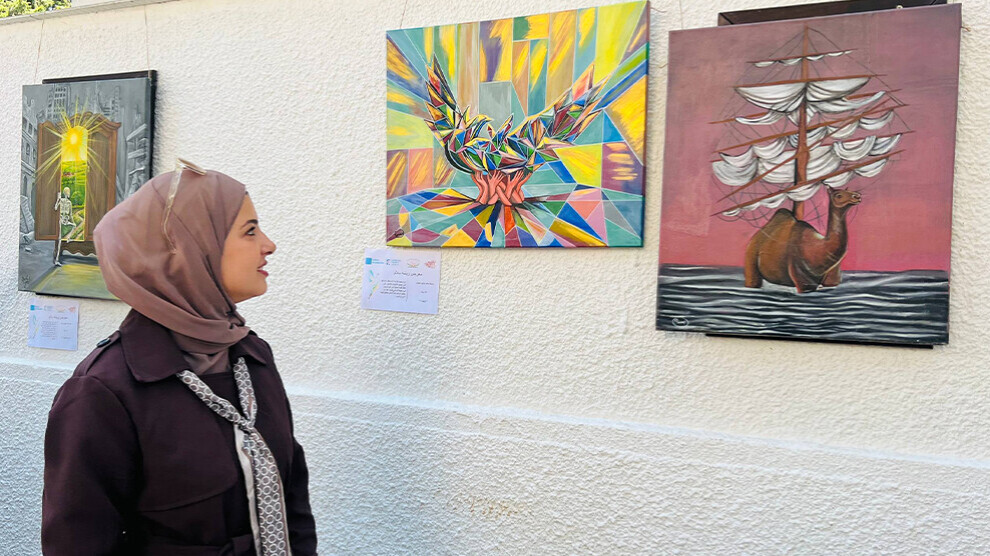
RAFIF ESLIM
Palestine — The Palestinian Women Graduates Association, in partnership with other institutions, organized its "Rishat Salam" (Brush of Peace) art exhibition on Sunday evening, August 30, with the participation of 22 female artists who presented paintings with different ideas expressing themselves, their homeland, and the peace that has been lost for three years, under the slogan: "Young women paint hope and peace with their brushes."
Haifa Shihabir, Director of Programs at the Women Graduates Association, said that the "Rishat Salam" exhibition emerged from the "Young Women Peacemakers" project, funded by the European Union and the French Foundation, and the Palestinian Working Women Association for Development. She noted that the goal of the initiative is to strengthen Palestinian identity, resilience, and civil peace.
She pointed out that the exhibition involved 22 young women who produced 30 paintings, each expressing her vision and dream to feel peace and security. She explained that "the difficult situation we are going through, the burdens and pressures, made it important to find a space like that provided by Rishat Salam for art training and psychological support." She noted that they faced several difficulties in obtaining raw materials, especially colors, so they had to work with what was available to support creative energies.
Visual artist Tihani Skik, one of the exhibition visitors, noted that she was struck by the artists speaking with boldness beyond their age group, perhaps due to what they experienced during three years of war—fear disappeared and was replaced by boldness and absolute eloquence. She indicated that they are still beginners, but they presented their ideas in a dazzling way that makes any visitor to the exhibition feel happy and enjoy the beauty of the time spent contemplating the paintings.
She advises the artists to work on themselves so that they can leave their own mark, no matter how much the colors and subjects of their paintings change, so that the viewer can recognize them through their work. Today, through a simple look at the paintings, one can tell who relies on talent and who worked until they achieved that final outcome. She noted that art is the tongue that expresses the citizen—the brush needs no interpreter, so all messages that reach the world are clear and not subject to interpretation or exaggeration.
Artist Nada Al-Qouqa explained that her participation in "Rishat Salam" was through two paintings: the first titled "Rooting of the Soul" and the second "Birth." The first came as an expression of the Palestinian woman's clinging to the land, identity, and everything related to Palestine, embodied through the woman who suffered during three years of war and continues to suffer as she completes the path she began. The anemone flower was also included as a wild flower that grows on its own in the lands and fields of Palestine to spread beauty—and so is the woman.
As for the painting "Birth," she explained that she chose the goldfinch because it is the closest bird in color to the Palestinian flag, and placed basil with it, which gives beauty. She noted that they faced several difficulties, including obtaining raw materials, as any flammable materials are prevented by Israeli forces from entering. She added that "Rishat Salam" gave them the opportunity to express what is inside them and what they dream of happening in the coming days, especially since art is a language like a melody that everyone understands—hence the importance of painting, which says: "Let us live."
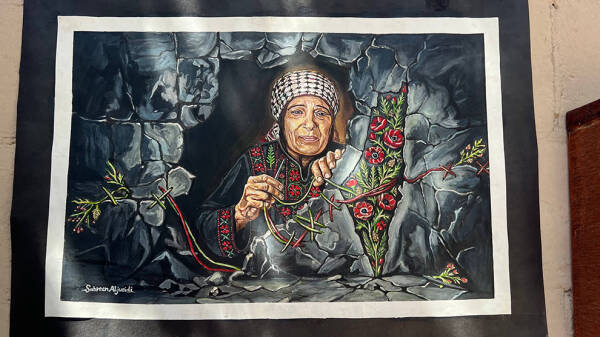
While artist Inas Al-Rayes said she participated in the exhibition to express a part of herself through art and share her artwork with a group of people through her painting "Memory of a Homeland," through which she expressed the city of Gaza, especially since what is destroyed from a place cannot be erased from memory, and the stricken city will one day awaken from its rubble and return to its beauty and pride as it once was.
For her part, artist Asma Awad explained that she joined the exhibition because it was organized through the efforts of a group of female artists, and she presented her vision through the painting "Rebirth," using the skull and drought to express pain, reflecting in another scene a woman from whom a new spirit and hope that creates happiness are born. She indicated that "Rishat Salam" means to her the comfort and reassurance she feels when she passes the reflection of her brush over the canvas.
Artist Malak Kaabar participated with her painting "When Time Stopped," using only two elements—charcoal and paper. She embodied in the painting the state she was in when the war of October 7 broke out. The compass symbolizes the stopping of life, the woman symbolizes the society she lives in, and the olive tree symbolizes her belonging to her land despite its uprooting, with a spider's web on it. She noted that art overcomes any difficulties to bring joy to the audience and people through these paintings, which support her psychologically and brought her back to her old self.
Laila Al-Jaidi, one of the visitors, said she came to the exhibition to support her daughter and all the young women participating in the exhibition, noting that it is beautiful to embody the resilience of Palestinian women through paintings and document their ongoing struggle from the Nakba and beyond. Despite her grief over her three sons who were killed during Israeli airstrikes and her heart weighed down with worries, she chose today to wear her traditional dress that represents her heritage, stand beside the young women, and applaud them for this achievement.