
Participants in a Seminar Demand the Re-inclusion of Tunisian Women’s Issues Among National Priorities
Regional seminar participants agree solidarity is the essential path to protect feminist, and rights struggles in the Maghreb amid rising right-wing parties targeting women.
ZOHOUR AL-MASHRIQI
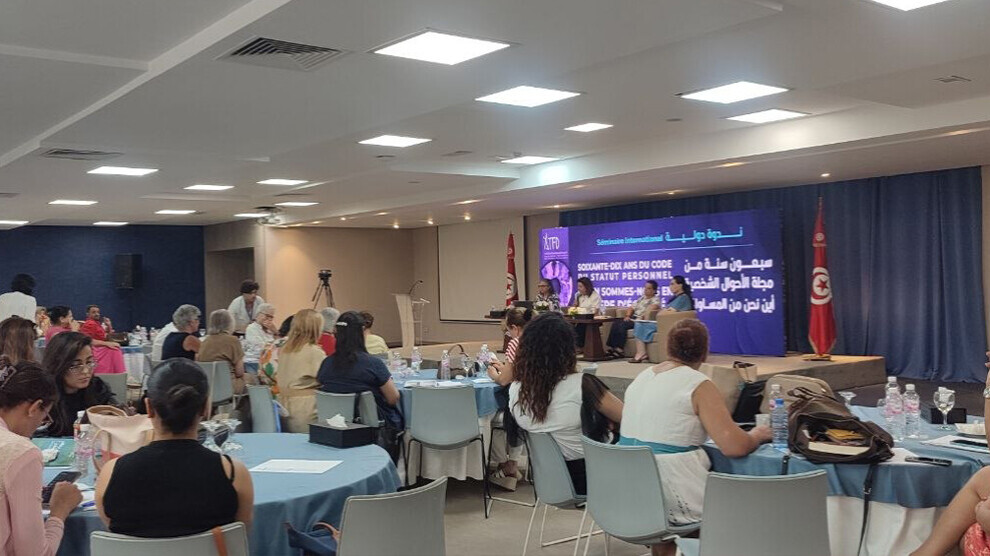
Tunis_The Tunisian Association of Democratic Women held a two-day regional seminar on Wednesday, August 12, with the participation of activists from Tunisia and abroad, in celebration of the 70th anniversary of the promulgation of the Personal Status Code.
On its second day, the regional seminar hosted by Tunisia, discussing personal status laws in the region, addressed the reality of women in Syria, Iraq, Palestine, Sudan, Lebanon, and Morocco. The speakers focused on developments that were the product of ongoing feminist struggle but are now threatened by the dominance of the right-wing or the rise of forces hostile to women's rights in the aforementioned countries, in addition to the failure to prioritize women's issues under the slogan "it's not the right time." The speakers emphasized the importance of solidarity and coordination as the primary path for defending women's rights.
Moroccan activist Aatifa Timjerdine opened her intervention by expressing dissatisfaction with the Family Code, which she believes needs amendment to suit the reality of Moroccan women today, noting that it is no longer consistent with the present and the reality in which women are educated, contributors to economic production, and participants in political life. She affirmed that women must enjoy the same rights as men without discrimination, differentiation, or exclusion.
Nobahar Mustafa, Kurdish Feminist and Political Activist, Speaks About the Self-Administration Experience
For her part, Nobahar Mustafa, a Kurdish feminist and political activist, spoke about the experience of the Self-Administration of North and East Syria (specifically in Rojava areas) since 2011, which is considered a unique model of feminist organization at the regional level. This experience has created a radical rupture with prevailing patriarchal and traditional structures, considering women's liberation as the foundation for the liberation of society as a whole. "This approach has been institutionalized through the imposition of the principle of parity and joint administration in all aspects of civil, political, military, and economic life, so that no institution is headed by a woman alone or a man alone, but rather the position is occupied by two co-chairs—a man and a woman—with equal powers to ensure participatory decision-making and prevent the monopolization of power."
She noted that this political and structural empowerment has led to the building of an integrated community and legal protection system aimed at eradicating gender-based violence. Independent institutions were established, such as the "Women's House" and women's justice councils to resolve family and community disputes outside the framework of traditional obstructing courts, in addition to the establishment of the Women's Protection Units (YPJ), which played a pivotal role in confronting extremist organizations. On the legislative level, the "Social Contract" of the Self-Administration was approved, which clearly stipulated the prohibition of child marriage, the criminalization of polygamy, granting mothers custody of their children until the age of fifteen, along with the entrenchment of full equality in inheritance and economic gains.
She affirmed that despite the harsh surrounding conditions and complex geopolitical challenges—such as ongoing security threats, the imposed economic blockade, and the rejection of this model by central parties in Damascus and the rest of the opposition—the experience has proven relatively sustainable thanks to its reliance on the participatory economy and women's agricultural cooperatives. Kurdish women, alongside their partners from Arab, Syriac, Assyrian, and other components of the region, have managed to turn the Syrian crisis into an opportunity to re-engineer the social contract, transforming the experience from a mere emergency response to a power vacuum into an organizational reference that draws the attention of international feminist and human rights movements.
Palestinian Women Need Just Laws
For her part, activist and rights advocate Afaf Ghatasha said: "There is a unique and different situation in Palestine, perhaps different from the Arab and Maghreb region, as the Palestinian people are a people resisting under occupation and suffering from its fascist measures—whether in Gaza, the West Bank, or Jerusalem—and the ones bearing the greatest burden of these measures are women and families."
She affirmed that what the Palestinian people need, which does not conflict with the national struggle but rather strengthens it, is a system of just and equitable laws for women, foremost among them personal status laws and the family protection law against violence, in light of the continued manifestations of violence within Palestinian society. She emphasized the need for deterrent measures against abusers.
She pointed out that it is impossible to empower women and build strong personalities capable of engaging in national and political struggle without a fair legal framework that protects them from the various circumstances and details they face, including issues of custody, divorce, alimony, guardianship, and others. She affirmed the necessity for official authorities to fully realize that Palestinian women, who have been struggling for a century, need a system of just and equitable laws that enhance their presence and ability to continue their national struggle. "There are draft laws that have been in the works for years and were the result of community mobilization involving civil society, institutions, and parties, yet they have been shelved and not approved in recent times."
She added, in the interest of objectivity and fairness, that there is an attempt by the Ministry of Women's Affairs to revive discussion of this draft and place it back on the Palestinian legislator's table for approval. She noted that a few months ago, the Association for the Protection of Women Workers from Violence and Harassment in the World of Work submitted a memorandum and proposed amendments, like many other feminist institutions in both the West Bank and Gaza. She expressed hope that the ministry would take these amendments into consideration.
She added that this seminar, organized by the Tunisian Association of Democratic Women in Tunisia, is of great importance—stemming from the existence of multiple and diverse experiences on all levels, from Tunisia's rich and advanced experience, which "we always celebrate and learn from, and we try to take what can be applied in our Palestinian experience," in addition to the experiences of Lebanese, Iraqi, Syrian, and Moroccan women.
She noted that in the Arab and Maghreb region, women need to strengthen their roles in various existing networks, such as the "Nada Alliance." She called on women to join the Nada Alliance, which includes diverse streams and women from all over the region. She concluded her remarks by urging women to join these networks: "Join these summits so we can work together, share our experiences, struggle, and support one another."
No One Hears Sudanese Women
For her part, journalist and activist of the "No to Women's Subjugation" initiative, Naglaa Nourin, stated that the greatest and primary harm of war always falls on women, and they are the ones who pay the heaviest price, as wars are often waged and waged on their bodies. "If we look at what Sudanese women are witnessing, we see an unprecedented tragedy—they have been raped, killed, displaced, and uprooted internally within Sudan by both parties to the conflict. The matter has even extended to their being raped while fleeing through human trafficking networks and border crossers, and even inside the refugee and displacement camps they sought for safety, including by service providers themselves such as 'Médecins Sans Frontières,' with 55 cases of Sudanese women being raped recorded in one camp in Chad."
She said that despite this tragedy, the world, unfortunately, completely closes its doors in the faces of Sudanese women and men, noting that "women in Sudan are living an extremely harsh humanitarian situation, in the absence of international attention to the suffering of the Sudanese people and the catastrophe of the ongoing war there."
She emphasized that achieving peace has become an absolute necessity that enables everyone to live in safety and allows access to genuine feminist and rights-based gains. She believes it is impossible to make any progress in this field or amend personal status laws under the reality of war, explaining that as long as peace is absent and safety is lacking, women will not be able to take a single step forward.
She concluded by expressing hope that the Sudanese leadership, particularly the military institution, would realize the essence of the crisis and its real causes, and address Sudan's problems through a fundamental approach based on handing over power to civilians, enabling Sudanese women to achieve gains similar to the honorable achievements of Tunisian women.