
Our Agency's Correspondent Wins Fourth Place in the "Pulse of Gaza" Competition
Our correspondent Nagham Karaja won fourth place in the "Pulse of Gaza" competition for best humanitarian journalistic story, adding to her career documenting stories and women's issues in Gaza.
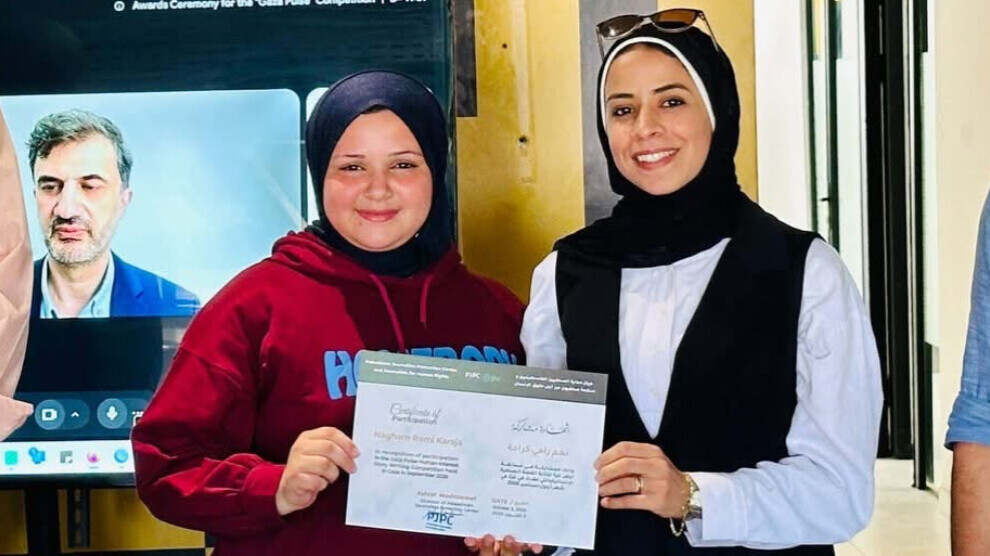
NEWS CENTER– Journalist and our agency's correspondent Nagham Karaja continues her presence in the humanitarian journalistic scene from the Gaza Strip, through her ongoing work in conveying the stories of women and civilians and documenting their experiences under war, displacement, and harsh humanitarian conditions.
Our agency "Nu Jinha" correspondent Nagham Karaja won fourth place in the "Pulse of Gaza for Writing the Humanitarian Journalistic Story" competition, whose results were announced yesterday, Saturday, the third of October, for her story "Jameel... When a Child's Body Grows Before Its Time," among about 100 male and female journalists who applied to participate. Twenty of them were selected for the final stage, before the names of four winners were announced.
The competition was organized by the Palestinian Journalists Protection Center in partnership with the Journalists for Human Rights (JHR) organization, with the aim of supporting humanitarian journalism and highlighting stories that document the experiences of civilians and shed light on their reality under the difficult conditions the Gaza Strip is experiencing.
Nagham Karaja's reaching the top four places comes as a culmination of her career in humanitarian journalistic work, especially through documenting the stories of women, children, and civilians from inside the Gaza Strip, and conveying their daily experiences under war, displacement, and their humanitarian and social repercussions.
The winning story addresses the tale of a nine-year-old child named Jameel, who suffers from congenital adrenal hyperplasia, before his health condition worsened following the interruption of his medication during the war, leading to the appearance of signs of early puberty and physical changes that made him vulnerable to mockery and isolation among his peers.
In her story, Nagham Karaja monitors the journey of his mother, Islam, in searching for the medication, moving between medical points and pharmacies in an attempt to secure the necessary treatment for her child, at a time when the family faces extremely difficult living and humanitarian conditions, forcing the family to displace, while Jameel's father lost his ability to work after being injured and having one of his legs amputated, which doubled the burdens borne by his mother, between following up on her son's treatment and securing the family's needs.
The story sheds light on the health, psychological, and social effects left by the interruption of treatment on the child's life, as he faces the consequences of physical changes, bullying, and isolation, alongside being deprived of practicing his normal life and returning to school.
Nagham Karaja's win reflects the importance of humanitarian journalism in giving space to voices that are often absent behind the numbers of war, and turning the individual experiences of women, children, and civilians into stories that preserve the details of their lives and suffering and reach the audience with a human face.