
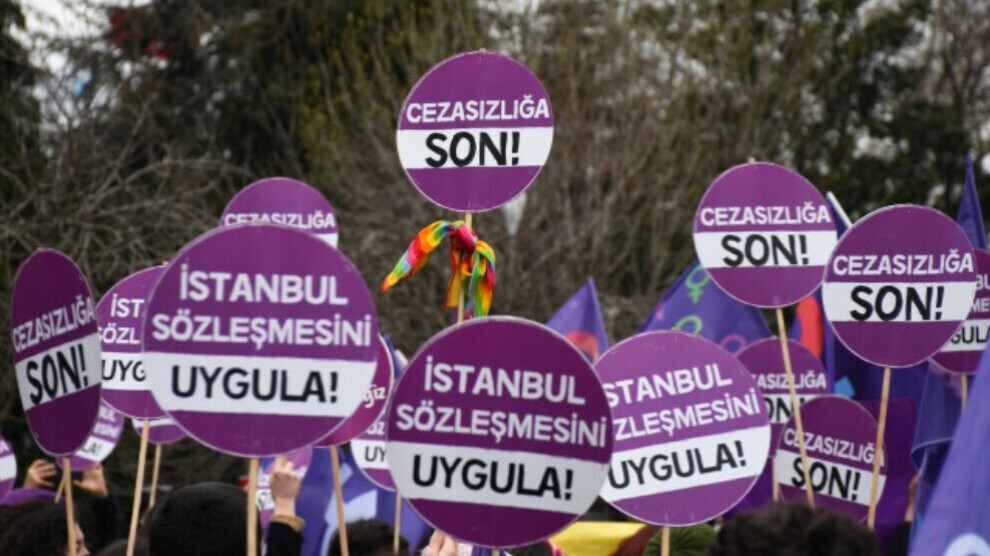
On the fifth anniversary of the withdrawal from the Istanbul Convention .. Less protection and more violence.
Five years after Turkiye withdrew from the Istanbul Convention, Question are being raised again about decision regarding the protection of women, In light of the escalating violence and the ongoing conflict between domestic law,international obligations.
ARJEN DELEK AWNGL
AMED- Befor Five years ago, on the night of March 20, 2021, a presidential decree unilaterally terminated Turkey's membership in the Council of Europe Convention on Preventing and Combating Violence against Women and Domestic Violence, known as the Istanbul Convention. Just three days later, the Council of Europe was formally notified of the withdrawal, marking the beginning of a new chapter in the country's record on protecting women from violence.
By decree signed by President Recep Tayyip Erdoğan, July 1, 2021, became a watershed date: the day the Convention ceased to apply in Turkey.
Since that date, women have not rested. The withdrawal was not merely a legal step; it became a social and political flashpoint, prompting women and their organizations to continuously defend the Convention as one of the most important tools of protection they suddenly lost.
Over the past five years, the effects of the withdrawal have become increasingly apparent. Monthly reports issued by women's organizations paint a grim picture; a significant increase In femicides, there has been a rise in mysterious deaths recorded as "suicide" or "suspicious death."
The impact extends beyond statistics. Withdrawal has fostered a climate of impunity, as courts have become less willing to issue protective orders under Law 6284, which is now considered the last line of defense for women experiencing violence.
Numbers Reveal a Worsening Pattern
The figures recorded since the withdrawal from the Istanbul Convention reveal an escalating trajectory of violence against women—a trajectory that cannot be ignored.
Thus, five years after the Convention's termination, the effects of the decision are evident in women's daily lives: less protection, more violence, and a legal recourse that is weaker than before withdrawal. Despite this, women continue to advocate for the Convention, viewing it as a symbol of justice and a guarantee they demand be restored. Figures Reveal a Worsening Pattern
The figures recorded since the abrogation of the Istanbul Convention reveal an escalating trend of violence against women, a trend that cannot be ignored. In the last five months of 2021 alone, 143 women were killed. The following years then painted an even darker picture: 381 women in 2022, 315 in 2023, 394 in 2024, and 299 in 2025, all killed by men. The first half of 2026, from January to June, saw at least 151 women killed.
The picture is not limited to documented murders, but also includes deaths recorded as "suspicious," a category that reveals the fragility of investigations and the lack of transparency. In the same period of 2021, 105 women died in The circumstances were described as suspicious. The number then rose to 245 cases in 2022, 270 in 2023, 259 in 2024, and reached 297 in 2025. In the first six months of 2026, women's organizations recorded 170 suspicious deaths of women, an indicator reflecting the widening gap between violence against women and the state's ability to investigate or prevent it.
"The Istanbul Convention considers inequality a violation of human rights.
" Lawyer and Executive Board Member of the Women's Rights Center at the Amed Bar Association, Nazli Matur, explained that the Istanbul Convention does not view violence against women or domestic violence merely as crimes to be addressed within the framework of criminal law, but rather as a consequence of historical and structural inequalities between women and men, and of gender-based inequalities. It defines them as violations of human rights and forms of discrimination.
She added that this definition also places upon states the responsibility of establishing preventive mechanisms to stop the occurrence of violence.
"The goal was to create a comprehensive public policy," she said.
She noted that the convention obligated states to provide a sufficient number of shelters, counseling centers, and support lines, in addition to training police officers and public officials, and providing protection for victims. She added, "The aim was to transform the fight against violence against women from mere responses to individual complaints into a comprehensive and integrated national public policy."
She pointed out that one of the most important aspects of the Istanbul Convention is that it recognized for the first time, at the international level, the crime known today as "persistent harassment" as an independent type of violence, referring to Article 34 of the Convention, which criminalizes repeated acts that may cause a person to feel fear for their safety, such as persistent tracking, surveillance, repeated contact, or persistent harassment.
She added that at that time, the Turkish Penal Code did not contain a specific provision criminalizing "persistent harassment" independently, so victims were forced to resort to other legal articles such as those related to threats, insults, or disturbing the peace.
She explained that after Turkey withdrew from the Convention, the Turkish Penal Code was amended in 2022, making "persistent harassment" a separate crime under Article 123, thus addressing one of the most significant legislative shortcomings that had been the subject of long-standing criticism.
GREVIO Monitoring Mechanism
Nazli Matur also emphasized another important aspect of the Convention concerning the monitoring mechanism, explaining that the Convention did not leave states' obligations at a theoretical level, but rather established a robust monitoring system.
At the heart of this system is the Group of Experts on Violence against Women and Domestic Violence (GREVIO), an independent body composed of experts. She said that this mechanism operates as follows: "States Parties submit periodic reports on the implementation of the Convention. GREVIO studies these reports, listens to the views of women's organizations, bar associations, and civil society organizations, and conducts field visits to countries, meeting with official institutions and representatives of civil society. Although GREVIO does not have the authority to impose direct sanctions, its reports create significant pressure in terms of international monitoring and accountability for states."
What is the difference between a law and a convention?
Lawyer Nazli Matur addressed the relationship between Law No. 6284 and the Istanbul Convention, explaining that Law No. 6284 is a domestic law that focuses on providing practical and rapid protection measures in emergency situations, and specifically on protecting women after an act of violence has occurred. In contrast, the Istanbul Convention targeted the root causes of the problem, namely gender inequality, which leads to violence in the first place, and thus represented a broader international framework.
“A decision contrary to the spirit of the constitution.”
She believes that withdrawing from the Istanbul Convention contradicts the hierarchy of laws and the spirit of the constitution, stressing that returning to the convention is legally possible through two paths. The first is legislative, whereby Parliament adopts a new law and re-ratifies the convention, then the President approves, re-signs, and informs the Council of Europe, thereby making Turkey an official party to the convention again. The second is administrative, which is the possibility of rescinding the withdrawal decision with a new presidential decree, should the political will or government policies change.” She emphasizes that the issue is not only about the existence of legal mechanisms, but also about political will and societal consensus. “We, as human rights defenders, feminist organizations and bar associations, did not accept this withdrawal. Returning to the agreement is not just a legal procedure, but means the state’s acceptance of submitting once again to international human rights standards, the rule of law and international oversight.”
"Turkey was the first country to sign the agreement."
Activist Esra Çiçek reminded everyone that Turkey was the first country to sign and ratify the Istanbul Convention on May 11, 2011. She pointed out that there is a misconception that the agreement was imposed on Turkey, explaining that the opposite is true, as it came about as a result of a pressing internal need, especially after the Nahid Obuz case in court.
The European Court of Human Rights condemned Turkey in 2009 for failing to protect women from domestic violence and discrimination.
It stated that Turkey's withdrawal from the Convention was illogical because, immediately afterward, Law 6284 was enacted as its internal extension. The law remains in force but is not effectively implemented, and its preamble stipulates that in the absence of a legal provision, the Istanbul Convention shall be applied, thus implying its continued legal effect indirectly. Gender Inequality
She emphasized that the slogan "The Istanbul Convention Protects Life" was based on the observation that femicides decreased after the convention was signed, but in recent years the numbers have risen dramatically.
She added that the current situation is now being described as "femicide," with an average of two women killed every day. She concluded by stressing that the struggle will continue on the part of women's organizations to defend the right to life and confront gender-based violence.