
Nusaybin and Qamishlo… Two cities separated by borders, whose distances have not erased them from memory
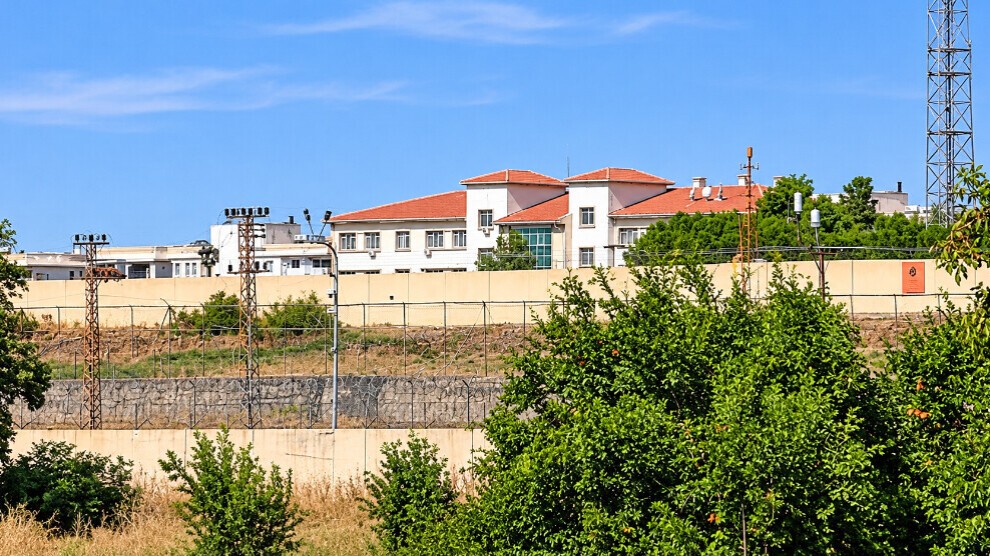
Once a minutes-long journey, now a 24-hour road: the Nusaybin-Qamishlo border has become a wall separating families, as Kurds on both sides renew demands to open crossings.
SORKIL SHEIKHO_AKIN STERK
NEWS CENTER_ For their residents, Nusaybin and Qamishlo were not two cities separated by political borders, but a single geographical and social extension, in which families, language, culture, and the details of daily life intertwined.
Moving between them required only minutes, and family visits and commercial activities were a natural part of residents' lives, before the border turned into a concrete wall, barbed wire, and trenches that severed what long years of human ties had joined.
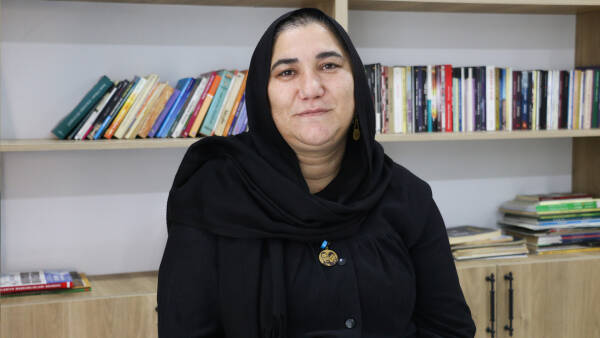
Amid this reality, Hilat Jeliq and Ghada Muhyiddin recall their stories with the border — not merely as a personal experience, but as a testament to the suffering of entire families and communities, and to a life that geography had brought together before barriers separated it.
24 hours separate Hilat Jeliq from her family
For 26 years, Hilat Jeliq has lived in Nusaybin in northern Kurdistan, while her family remained in Qamishlo in Rojava, where her mother and siblings reside. Between the two cities, separated by only a short distance, a border now stands that has turned the meeting of loved ones into a journey requiring a full day of travel.
She bitterly recalls the days when the crossing was open, when she could reach her family in just five minutes, before the short road turned into a long journey passing through the Kurdistan Region to reach Rojava. "The border crossing was open, and I used to reach my family in just five minutes. Today I need 24 hours to cover the road and meet them."
It was not only the distance that changed; the details of family life changed with it. Visiting one's mother or checking on one's siblings is no longer a decision that can be made easily, but a journey requiring financial means and time that are not always available.
A border that deprived her even of bidding farewell to her siblings
But the harshest thing Hilat Jeliq carries in her memory is not related to the length of the road or the costs of travel, but to the moments when she could not be at her family's side. "When a person is deprived of their family, land, and homeland, longing grows in their heart day after day. Two of my siblings were martyred, and my father died affected by those events, and I could not even arrive in time to take part in bidding farewell to my two siblings."
Today, she stands helpless before her mother's illness, as her mother has become bedridden, while her longing for her grows with every passing day.
Her relationship with Qamishlo does not stop at memories of absent visits; life near the border makes her live daily with what comes from the other side. The sounds that reach from there, even children's voices, awaken within her questions about her family, and sometimes push her to climb to the roof of her house to follow what is happening in Rojava.
She says: "When a fire breaks out in Rojava or anything happens there, I rush to the roof of the house to see what is going on. Even when I hear a child's voice coming from behind the border, I wonder if it is one of my family members. We hear from here the sounds coming from the other side."
Even demanding peace has become a reason for prosecution
Hilat Jeliq's suffering was not limited to being away from her family; it extended to judicial prosecutions and a travel ban abroad, which for a time prevented her from visiting Rojava.
During the attacks on the region, she participated in a guard sit-in on the border in the city of Nusaybin that lasted 29 days, as an expression of her solidarity with her family and the people of her people on the other side. However, this participation exposed her to prosecution and trial.
She explained: "We held a sit-in on the border in Nusaybin during the attacks on Rojava, and today I am being tried because I said: We are Kurds and we want peace. A case was filed against us merely for demanding the opening of the border. During that period, we could not go to Rojava, and our families could not reach us either."
For Hilat Jeliq, the issue cannot be reduced to a closed crossing or a wall separating two cities; she sees that what is happening targets the ties that bind Kurds, affirming that geographical, linguistic, and cultural proximity cannot be erased by political borders.
She says: "There is no distance between Nusaybin and Qamishlo; all they placed between us is a border wire, so we tell them: Remove the borders. They say Kurdistan is four parts, but it is one part. They are trying to divide us with these borders, but I have relatives in all four parts of Kurdistan, and we Kurds are always one people."
Hilat Jeliq pins her hopes on the peace and democratic society process opening the way to ending the restrictions that separated families, affirming that her basic demand is that people be able to visit their loved ones and move freely, without short distances turning into long transit journeys.
Qamishlo and Nusaybin... the memory of one city
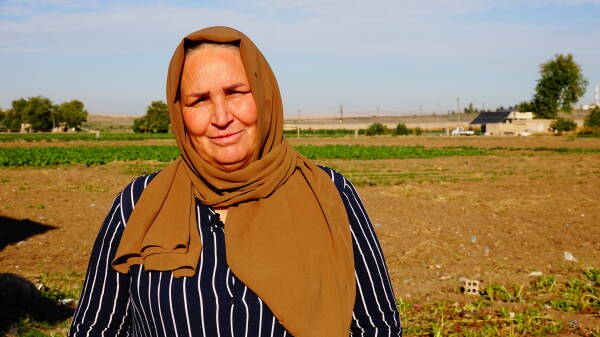
The same is true for Ghada Muhyiddin, who has lived in Qamishlo for forty years; she carries in her memory a completely different image from the reality of the border today. Her house near the border strip makes her a witness to the transformations that have taken place in the region, and to the transition from a life in which the two cities were interconnected to a reality governed by walls and fortifications.
Ghada Muhyiddin recalls days when the crossing was open
Ghada Muhyiddin recalls days when the crossing was open, and family visits and trade between Nusaybin and Qamishlo were part of daily life, as residents would cross in the morning to visit their relatives and return in the evening, or stay several days before returning. "The border crossing was open and trade between the two countries was flourishing. We used to go in the morning to Nusaybin to visit our relatives and return in the evening to Qamishlo, and sometimes we would stay two or three days and then return. But border procedures tightened in recent years, concrete blocks were placed, and the crossings were closed, so the life we were accustomed to changed."
For her, the wall was not merely a concrete structure added to the geographical scene, but the beginning of the dismantling of an entire social life. The closure of the crossings and the tightening of procedures severed kinship ties between families, leaving many unable to meet their relatives for long years.
She points out that the effects of the border went beyond social isolation to reach the safety of the residents themselves, as repeated attacks along the border strip left injuries and suffering among the people.
She recounts that the son of one of her neighbors was shot by forces stationed on the border, and is still unable to walk to this day. "This wall was built against the interests of the Kurdish people on both sides of the border; they do not want us to live a shared life. By building the wall and closing the crossing, they separated the two cities and the two parts of Kurdistan. There are women who married in Nusaybin and have not been able to see their families for 15 years."
A journey across borders to reach one's neighbors
Ghada Muhyiddin describes the paradox that residents live today: people separated by a distance of less than one kilometer now need passports and to cross the borders of the Kurdistan Region in order to visit one another.
She recalls the image of the two cities before the wall was built, when they were like a single city whose neighborhoods and residents' lives overlapped, before fortifications, barbed wire, and trenches cut off this extension. "Qamishlo and Nusaybin were previously one city. There was a lower line and an upper line, but they formed one unit. Now they have built a wall between us, placed wires on top of it, and dug trenches behind it. Today, in order for us to be able to visit one another, we have to obtain passports and cross through the borders of the Kurdistan Region so we can meet, even though we are children of the same land and neighbors to one another. And whoever does not carry an ID or document cannot go or return, even though the distance between us does not even reach one kilometer."
She believes that this separation cannot erase what binds Kurds in the various parts of Kurdistan, considering that historical and social ties and the shared land are stronger than the borders imposed on them.
She holds Turkey and Syria responsible for obstructing the Kurds' aspirations for freedom and recognition of their rights and political status, but she affirms that the reality of deprivation will not last forever, and that the Kurds will obtain their rights and have a presence in decision-making institutions. "The Kurds in the four parts of Kurdistan have a common cause and a land that brings them together, and therefore they cannot be separated from one another. They do not want the Kurds to be free, but this situation will not continue as it is. We too will obtain our status, our rights will be enshrined in the constitutions of states, we will be represented in parliaments, and we will have a role in decision-making."
"We want borders without walls"
Amid talk of the peace and democratic society process in northern Kurdistan, Ghada Muhyiddin believes that any solution that does not guarantee the constitutional rights of the Kurds and does not restore social relations between the two sides of the border will remain incomplete.
She stressed the importance of recognizing the Kurdish language and granting it official status, and ensuring Kurdish representation in constitutions and state institutions, but she affirms that these steps should be accompanied by opening the crossings and removing the walls, in a way that allows the restoration of family communication and trade exchange between the regions.
She explained that freedom of movement is not a demand separate from political and cultural rights, but an essential part of residents' lives and their right to communicate with their relatives and live in their social environment without restrictions. "The Kurds must have a place in the constitution, and the Kurdish language must first become an official language. But these things alone are not enough. The border crossing must be opened and the wall that separates us must be demolished. In this way, our social relations will be strengthened again, and trade between the regions will also develop."
She evokes the model of the border between Germany and Switzerland, where geographical lines do not turn into walls that isolate communities or prevent residents from communicating, considering that the border between Rojava and northern Kurdistan should not be an obstacle to people's lives. "The border here should be similar to the border between two European countries, like Germany and Switzerland. Their border is nothing but a line drawn on the ground, and there are no barriers between them."
One wall and endless stories
Between Hilat Jeliq, who needs 24 hours to reach her mother, and Ghada Muhyiddin, who recalls days when visiting relatives required only a short crossing, the story of two cities separated by borders is embodied, yet those borders could not erase what binds their residents.
Behind the concrete walls and barbed wire, there are still families waiting to meet, mothers longing to see their children, children deprived of knowing their relatives, and memories of a life in which Nusaybin and Qamishlo were too close for barriers to separate them.
What Hilat Jeliq and Ghada Muhyiddin demand is not merely an open road between two cities, but the restoration of a human right to meet, a societal right to communicate, and a life in which walls do not stand between a person and their family.