
Marrakech Folk Arts Festival concluded, highlighting women's notable presence in Moroccan heritage.
The 22nd Marrakech Folk Arts Festival concluded, drawing large crowds to diverse Moroccan folklore performances that highlighted women's prominent role in reflecting regional cultural identity.
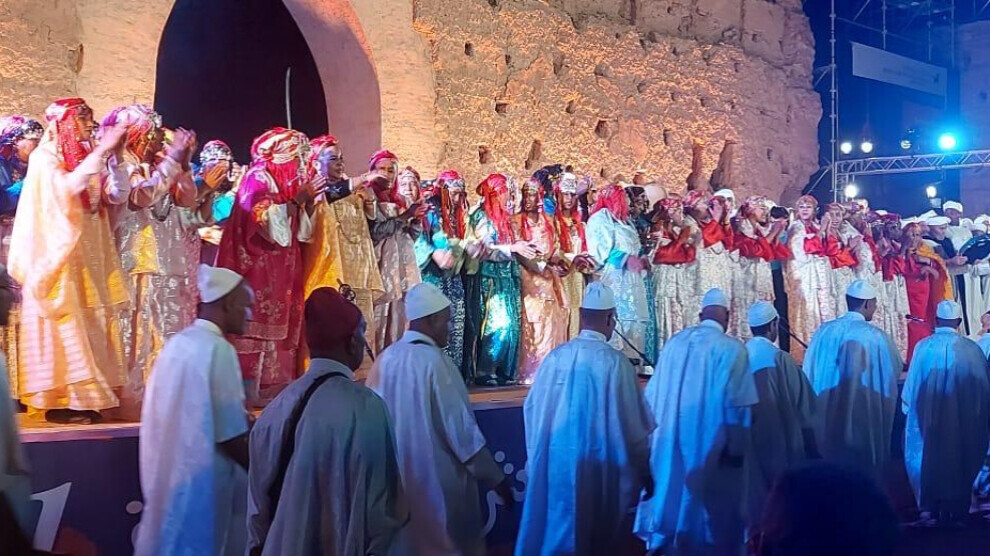
Morocco – In a festive atmosphere, the female participants in the folk groups affirmed their prominent presence at the festival, highlighting through their dances and songs the role of women in preserving heritage and safeguarding cultural identity. They emphasized the symbolic significance of their presence in aesthetic expression and in strengthening the values of cohesion within society.
The 55th National Festival of Popular Arts in Marrakech concluded on Monday evening, July 6th, with a closing ceremony featuring popular artist Zina Daoudia, along with folk groups who presented artistic performances blending rhythms and dances, embodying the diversity of Moroccan cultural heritage.
For four days, the audience was captivated by artistic performances and songs from across the country. The presence of women added a special touch through their dances, songs, and traditional costumes, highlighting their connection to Moroccan cultural identity. Each performance showcased the unique character of its region, with its rhythms, songs, and dances in which women played a prominent role, demonstrating the dancers' deep connection to their local culture and natural environment.
"Tazwit" Embodies the Bee's Hive
The "Tazwit" troupe (meaning "bee" in Berber) from the Qalaat M'Gouna region, the "Rose Capital" of southeastern Morocco, presented their Bee Dance, captivating the audience in Marrakech who flocked to the El Badi Palace, a historical landmark that hosted a variety of folkloric performances by participating groups.
Saadia El Asri, a member of the troupe, explained that the Qalaat M'Gouna region is famous for the Bee Dance performed by the "Tazwit" troupe. In the dance, the leader, the Rais, embodies the queen bee, surrounded by women representing bees who move in synchronized dances according to his gestures. On the opposite side, the men of the troupe perform rhythmic movements in harmony with the women, representing the hive's soldiers.
She pointed out that the dance is not limited to "Al-Nahla" (the bee), but also includes "Ahidous," an Amazigh art form performed at weddings and special occasions such as the naming ceremony (Aqiqah), circumcision, and other celebrations. She emphasized that the presence of women within the troupe is essential, as the women wear wreaths of roses, symbolizing the region's unique heritage of rose production. Amazigh women, she added, represent a symbol of heritage and culture, and are the primary bearers of this legacy across generations.
"Al-Kadra," the Gateway to the Sahara
In the Wadi Noun region, the gateway to the Sahara, Laila Zahrawi, a member of the Al-Kadra troupe for Hassani music and dance, explained that the troupe has been participating for years.
At the National Festival of Popular Arts, her presence has become a family tradition, with members of the troupe bringing their children. The festival, now in its fifty-fifth edition, is considered one of the most prestigious artistic events in Morocco.
Regarding the art that distinguishes the region, she emphasized that the "Guedra" dance is a hallmark of the Guelmim region, unlike other Saharan regions, due to its special symbolism within Hassani culture, which forms an integral part of the identity of the Saharan people. This dance relies on the rhythm of the "Guedra," a hand-beaten drum performed by women who gather around the Guedra player, kneeling and performing rhythmic, synchronized movements, focusing on head, shoulder, and hair movements. They wear the traditional Saharan dress called the "Melhfa," while those around them respond with applause. Men and women join in the singing and clapping, reciting folk poems that express pride, love, and welcome.
She explained that the "Kedra" dance carries deep cultural and social significance. It is a means of expressing joy and Sahrawi identity, and it reflects the values of solidarity and communication within the community. She noted that the Kadra dance symbolizes these values, with the woman in the center of the circle reflecting her status in Sahrawi society as the focal point of movement and aesthetic expression within the festive ritual.
The men and women surrounding the dancer symbolize social cohesion and the unity of the tribe. The Folk Arts Festival reflects the rich cultural diversity of Morocco's regions, from "Ahwach" and "Ahidous" which characterize the mountainous regions, to the Hassani heritage that characterizes the desert regions, the Aita art that abounds in the plains, and the art of "Knafeh" with its African roots. It also highlights the symbolic status of women in society.