
From Egypt to the Middle East... Jineology Center Presents a New Research Vision for Women's and Social Issues
The Jineology Center promotes an open, collaborative research approach to examine women's and social issues through a scientific perspective, addressing the Middle East's evolving challenges while fostering regional dialogue and knowledge.
ASMA FATHİ
Cairo — Today, there is a growing need to develop new research perspectives capable of examining women's issues in the Middle East through an approach that goes beyond traditional frameworks, particularly in light of the rapid political, social, and technological transformations that have revived questions related to justice, equality, rights, and social participation. In this context, the Jineology Center for Thought and Research has emerged as an initiative seeking to create a knowledge-based space that relies on scientific research, dialogue, and knowledge production as tools for change.
The opening of the Jineology Center in Egypt nearly a month ago has raised questions about the concept of "Jineology" as a field of study that examines society in all its components. Rather than focusing solely on women's issues, it seeks to provide a broader understanding of social, cultural, and political relations, as well as the challenges facing societies across the region, based on the belief that knowledge is a fundamental gateway to sustainable change.
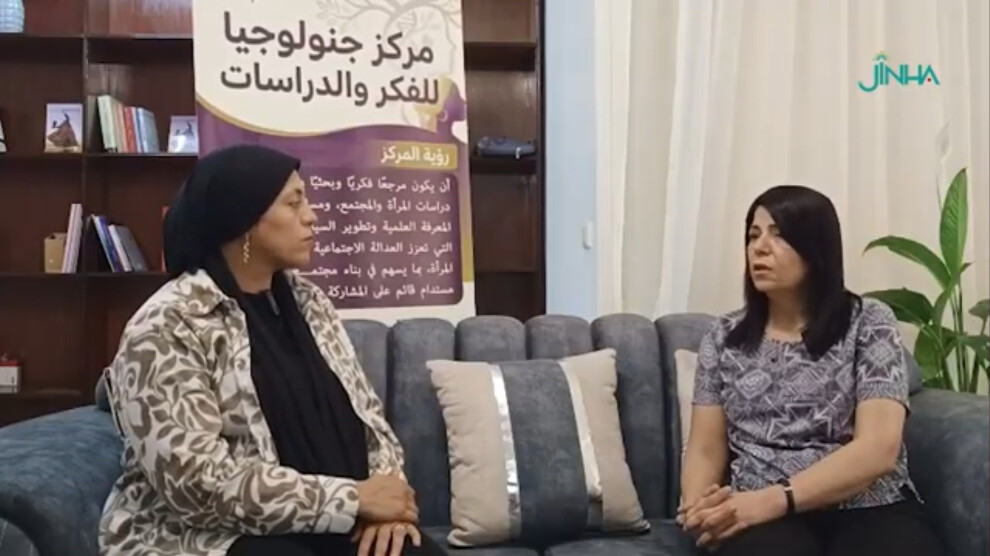
To learn more about the motivations behind establishing the center, the reasons for choosing Egypt as its headquarters, its vision for the coming phase, its research priorities, its plans to build partnerships with women's organizations and academic institutions, and its role in supporting researchers and producing research that is more closely connected to reality, our agency interviewed Noujin Youssef, Executive Director of the Jineology Center for Thought and Research.
To begin with, could you introduce the idea behind the center? Why did you choose the name "Jineology," and what motivated you to establish it at this particular time?
The idea of Jineology did not emerge overnight, nor was the establishment of the center a spontaneous decision. Since 2025, continuous discussions have taken place around the concept of Jineology, the transformations taking place across the region, and the need for an intellectual and research space capable of engaging with these changes from a different perspective.
We chose the name "Jineology" because Jineology is fundamentally a science, and science cannot be confined to a single field. It intersects with political, social, cultural, and economic life and views society as an interconnected system rather than treating women as an isolated issue separate from their broader environment.
Although the term "Jineology" may still be relatively new in Egypt and the Middle East, it is not new as either an intellectual framework or a practical experience. Over the past period, we have witnessed growing interest in this concept through the meetings and activities we organized. People increasingly began asking: What exactly is Jineology? Why is this field being introduced now?
This interaction encouraged us to establish a specialized center for thought and research aimed at developing the capacities that already exist within society, making better use of them, while at the same time producing new knowledge and contributing to its dissemination.
In reality, Jineology does not need a center in order to continue existing because it is an idea before it is an institution. It is a field of knowledge that can be practiced anywhere. We have researchers and people interested in Jineology working across Europe, Lebanon, Syria, Turkey, Iran, and Latin America, each applying this science within their own societies according to local needs and circumstances. However, having a research center provides the idea with an institutional framework that allows knowledge production to become more organized and sustainable.
How do you view the role that Jineology can play in bringing about change within societies, particularly in light of the challenges facing women across the region?
Today, we are living amid major societal challenges. Even if we speak only about women, we find thousands of issues that require genuine attention.
We need intellectual change and a reconsideration of many prevailing concepts. Such change will not happen overnight, but it begins by asking the right questions and reexamining the terms and ideas we have long taken for granted.
We believe that the twenty-first century will not only be the century of technology, but also the century of women—the century in which women can further develop their presence and achievements in the fields of thought, culture, politics, diplomacy, and technology.
From this perspective, Jineology does not view women as an isolated issue. Instead, it examines the relationship between women, men, children, and society as a whole, seeking to build a framework based on justice, equality, and partnership.
When we look at the conflicts and wars taking place across the Middle East, we find that women are often the first victims. For this reason, the need to produce new knowledge about women's realities has become more urgent than ever before.
In your remarks, you referred to laws and legislation as one of the key issues. How do you view the relationship between scientific research and legal reform with regard to women's rights?
We have many examples showing that the existence of laws alone is not enough. The core issue lies in how these laws are drafted and implemented.
I have Sudanese friends who are lawyers, academics, and holders of master's and doctoral degrees. Whenever we discuss Jineology and women's rights with them, we discover a significant gap between legal knowledge and women's actual ability to benefit from these laws.
We discuss issues such as political participation, parliamentary representation, sexual violence during conflicts, and rape in war zones. These are all issues that require both legal and societal responses.
We also believe that some religious and social discourses promoted in certain countries continue to reproduce stereotypical images of women. This makes the need for knowledge and science even more urgent, because real change begins with ideas before it reaches the law.
For this reason, we see Jineology not merely as a theoretical framework, but as a space for generating ideas that can gradually evolve into policies, legislation, and more just social practices.
Drawing on your field experience, particularly during your years of work in North and East Syria, how has this experience shaped your perspective on women's issues, and what has it contributed to the concept of the Jineology Center?
My fourteen years of experience in North and East Syria, particularly in a region that has witnessed conflict and complex challenges, have profoundly shaped my perspective. Despite war, hunger, humanitarian losses, and women carrying enormous burdens on the front lines, there was a genuine determination to develop civil laws concerning family affairs and women's rights, while working toward a model that ensured women's participation in public life.
At the same time, we witnessed how these achievements could change as political circumstances shifted. New laws and decisions emerged that restricted women's participation or reproduced traditional perceptions of their role. This demonstrates that women's rights are never guaranteed permanently—they always require intellectual, legal, and societal protection.
This experience reinforced my belief that women establish their place through their determination, strength, courage, and credibility. Any project seeking justice must create space for women to participate fully in decision-making.
For us, Jineology is neither a political party nor an organization. It is an idea and a method of thinking. We believe that the discussions we hold today may generate new concepts tomorrow, and perhaps even new laws, if they develop into collective action supported by genuine social will.
Transforming Jineology from an idea into an officially recognized research center must have involved challenges.
Why did you consider establishing a formal institution necessary?
As I mentioned earlier, Jineology itself does not need a center in order to exist. However, it required a legal and institutional framework to implement its programs more effectively.
During the registration process, we encountered a number of bureaucratic procedures. At the same time, we sought to reflect our principles within the institution itself. For example, we modified some administrative regulations so that signing authority would not be concentrated in a single individual, but instead be based on shared decision-making. For us, even administrative procedures should reflect the philosophy of participation that we advocate.
I do not believe that opening the center means the issues have been resolved. On the contrary, I feel that the real work has only just begun. The challenges are now greater because we do not want to stop at slogans; we aim to produce genuine knowledge and research capable of contributing to meaningful change.
We continue to face challenges related to prevailing mindsets, gender stereotypes, and patriarchal cultures that still influence many societies. Consequently, our responsibility today is greater than it was before the center was established.
What are the main issues the center will focus on during the coming period? Will its work be limited to women's issues?
Our research will not focus on a single topic or treat women as an isolated issue because we view society as an integrated whole.
We will examine themes including the concept of freedom, transitional justice, identity, gender-based violence, rape during and outside armed conflicts, female genital mutilation, and numerous other social and cultural issues affecting both women and society as a whole. We also attach particular importance to the changes the world is experiencing as a result of technological development, especially artificial intelligence.
You mentioned artificial intelligence several times. How do you view its impact on women and on research work?
We do not view artificial intelligence as an absolute threat, nor do we see it as a solution to all problems. Rather, we consider it a tool that requires critical study.
What we are observing today is that technology has begun to influence the way people think, write, and even experience emotions and human relationships. It is as if humans have started relying on machines to produce their ideas and positions. This requires us to seriously discuss the impact of artificial intelligence on women, society, and knowledge production.
Therefore, we will dedicate part of our research to studying the advantages and disadvantages of artificial intelligence and exploring how it can be used without becoming a substitute for critical thinking or human experience.
You also spoke about open research. What do you mean by this concept?
Unfortunately, many studies are completed and then remain hidden in drawers or are only accessible to a limited number of researchers. Our goal is for our research to be available for public discussion, allowing researchers, specialists, and readers to express their opinions, because truth is not built from a single perspective but through dialogue and the exchange of experiences.
We also seek to ensure that our research is connected to reality, rather than being merely theoretical reviews or reproductions of existing knowledge in books. We will rely on field studies, surveys, and monitoring social realities so that research findings emerge from people’s daily lives and can contribute to providing real solutions.
In addition, we will work on building partnerships with women’s organizations and various research centers because we believe that exchanging experiences is the fastest way to produce deeper and more influential knowledge.
For me, I feel that the coming phase is one in which we learn as much as we teach, and give as much as we receive. True knowledge is not built in one direction; it grows through dialogue and collective work.
Choosing Egypt as the headquarters of the Jineology Center for Thought and Research raises many questions, especially since you have networks and experiences in several countries. Why did you choose Egypt, and what does it represent for you intellectually and practically?
From my first visit to Egypt, I felt that it was the place where I wanted to work. This feeling was not only emotional; it was connected to what I found there: a cultural, intellectual, and civilizational environment capable of supporting the creation of a long-term research project.
The Egyptian people are highly educated, and there is a strong civilizational foundation. I believe that any intellectual project requires a society with history, culture, and the ability to engage in dialogue, and this is what I found in Egypt. Civilization does not only represent the past; it shapes the way we think in the present. Therefore, I always feel that working in Egypt gives us a genuine opportunity to produce knowledge connected to reality.
Egyptian women also have a long history of presence and influence. They are capable of embracing diversity and engaging with different components of society. This is something I have experienced during my time here. I have not only felt support from women, but I have also found encouragement from many academics, researchers, and Egyptian men who believe in the importance of this project.
From a legal perspective, having an officially registered center in Egypt provides us with greater space for institutional work and offers a clear framework for documenting our activities, programs, and research, strengthening the credibility and continuity of our work.
Egypt also represents a part of the region’s history for me. When I sit with Egyptian researchers, I find myself engaged in discussions that open broad perspectives on the history of women, civilization, archaeology, and identity, enriching any research project.
For me as well, I do not feel far from Syria while I am in Egypt. There are deep historical and cultural connections between the two countries, in addition to the historical presence of Kurds in Egypt. This makes me feel that we are working within a shared cultural space, rather than separate geographical borders.