
'Free Media Is Responsible for Revealing the Truth and Defending Women's Rights'
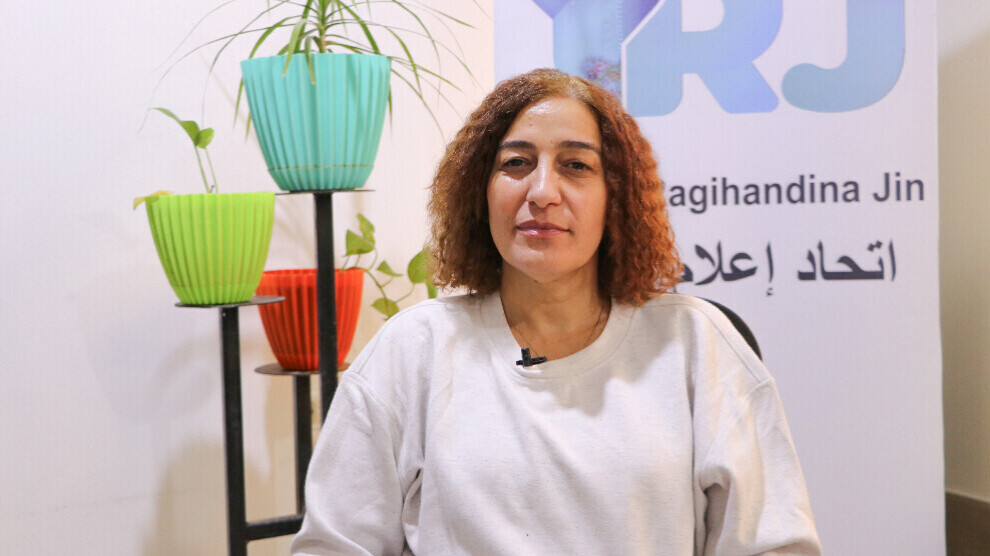
YRJ spokesperson Amal Mohammed said authoritarian media uses women's bodies to influence society's consciousness and reduce them to appearance, stressing free media's role documenting women's rights violations.
NAGHAM JAJAN
QAMISHLO– The use of a woman's body as a tool of domination is not limited to violating her freedom, but extends to influencing and directing society's consciousness. In the face of this, the importance of free media emerges in revealing the truth, breaking the silence, and defending women's rights, alongside the necessity of protecting female journalists from the pressures and threats targeting their work.
Regarding this issue, and the dimensions of the influence of authoritarian media on society through the exploitation of a woman's body, our agency conducted a dialogue with Amal Mohammed, spokesperson for the Women's Media Union (YRJ).
How does authoritarian media employ a woman's body to influence society?
Media plays a pivotal role in shaping society's consciousness, conveying facts, delivering the people's voice, and shedding light on their issues. However, this role changes when media is subject to the interests of power, turning from a means of revealing the truth and defending rights into a tool for directing consciousness, falsifying facts, and entrenching dominant interests.
In this context, the employment of a woman's body is one of the methods that authoritarian media resorts to in order to influence society. By intensifying images and scenes that make a woman's body and appearance the focus of attention, she is reduced to the standards of beauty and attractiveness imposed by the media, and her personality, consciousness, will, and role in social life are marginalized. Thus, the woman turns from a human being possessing rights and the ability to make decisions into a means of attracting attention, achieving commercial gains, and controlling consciousness.
This orientation is not limited to commodifying a woman's body, but extends to influencing the concepts of freedom, identity, and independence. On the one hand, women's demands for their rights and the protection of their cultural and social identity may be presented as a challenge to the interests of power, and on the other hand, individual and fragmented concepts of freedom are promoted, separated from actual rights, societal participation, and the struggle for equality.
Among the manifestations of this distortion is linking women's freedom to the extent of displaying her body or her compliance with appearance standards imposed by the media. Thus, the concept of freedom is reduced to external form, while more fundamental issues are marginalized, such as the right to safety, economic independence, and political and social participation. Freedom is not an appearance imposed on a woman, nor a single model she is asked to imitate, but is an inherent right to determine her destiny, express herself, and choose her lifestyle by her own will, without being subject to the authority of society or the dictates of the media.
The effects of this policy are exacerbated with the widespread dissemination of digital social media, where images and contents that link success and freedom to attractiveness, appearance, and the ability to attract attention are repeated. This discourse may contribute to entrenching narrow perceptions among youth, making external appearances a criterion for evaluating oneself and others, and weakening their ability to think critically about the media messages they receive.
The effects of this orientation do not stop at the limits of individuals, but may extend to social relations and the possibilities of solidarity among women. When freedom is presented as an individual choice separate from collective rights and social reality, interest in the common factors affecting women's lives declines, and it becomes difficult to build a collective vision to confront discrimination and oppression.
In return, shared awareness and women's solidarity constitute the foundation for defending rights, confronting forms of domination, and demanding a change in the conditions that limit their freedom. They are the ones capable of understanding their reality, adhering to their identity, and working together; they possess a greater ability to confront violations and contribute to building a society based on freedom and equality.
A woman is not just an element in the media scene, but is a fundamental actor in society, and has a role in protecting language, culture, and identity, and participating in shaping the present and the future. Therefore, marginalizing her experience or reducing her to her appearance not only diminishes her rights alone, but also limits society's ability to understand its reality and confront its challenges.
Hence, the responsibility of free media emerges in presenting an integrated image of women, showing their ideas, will, achievements, and struggle, and giving their issues a real space in public discussion. Responsible media does not content itself with conveying images and scenes, but reveals facts, enhances critical awareness, opens the field for women to express their experiences and voices, and confronts all forms of exploitation and misrepresentation.
What is the role of female journalists in documenting violations of women's rights and conveying their voice to society?
In Rojava, we began journalistic work under extremely difficult conditions. During ISIS's attacks, women were subjected to kidnapping, and we witnessed horrific crimes. Under those circumstances, documenting these crimes and conveying their truth to public opinion was a moral duty and a historical responsibility that cannot be abandoned.
Wherever a woman is subjected to oppression, discrimination, or violation of her rights, female journalists must be present to convey her voice and document her experience. Being a voice for women does not only mean speaking on their behalf, but also means providing the space for them to express themselves, narrate their experiences, and convey their demands to society. Fulfilling this pledge is not achieved by slogans alone, but by field work, precise documentation, and conveying facts honestly and responsibly.
Free media differs from authoritarian media in the way it views women and presents them to society. Authoritarian media may employ a woman's body and appearance to serve propaganda and commercial and political interests, while free media seeks to highlight her personality, ideas, will, struggle, and role in bringing about change.
In Rojava, women witnessed important transformations in their presence and societal participation. Journalistic work accompanied these transformations by conveying women's voices, documenting their struggle and gains, and shedding light on their roles in various areas of life.
Authoritarian media seeks to direct women's discourse in accordance with its interests, and may limit their ability to express their opinions and experiences freely. As for free media, it gives women space to speak in their own voices, express their ideas and positions, and reveal the violations they are subjected to, without imposing ready-made narratives on them or marginalizing their experiences.
The responsibility of female journalists does not end at revealing violations, but includes preserving memory, defending women's dignity, and conveying their voice to society. When a female journalist documents the truth, she does not only convey an event, but contributes to protecting rights, confronting silence, and opening the way for a more aware and just society.
How can female journalists protect themselves from attacks targeting their work?
Protecting male and female journalists in the face of difficulties and dangers is of extreme importance. Under the experience of the Autonomous Administration, security conditions provided opportunities for journalists to practice their work and document facts from the sites of events.
However, many male and female journalists who worked to reveal the truth of events, convey the voice of their people, and protect women's gains were subjected to targeting, and some of them even reached martyrdom. The attacks targeting journalists do not aim only to silence them, but also seek to conceal the truth and keep the people's voice muted.