
Feminist Protes in Baghdad Demands Protection of Mothers’ and Children’s Rights
Protesters in Baghdad demanded a review of Judicia Decision No. 93 to protect mothers’and children’s rights amid fears over the Ja’fari Code’s impact on marriage,custody,and family stability.
TAMANI AL-SARWI
Baghdad_The provisions of the Ja’fari Code have sparked widespread controversy in Iraq,as their effects have begun to extend to issues of marriage,custody,and women’s rights within the family.activists fear that the application of some of its articles could refuce women’s legal protections,particularly regarding the age of marriage.
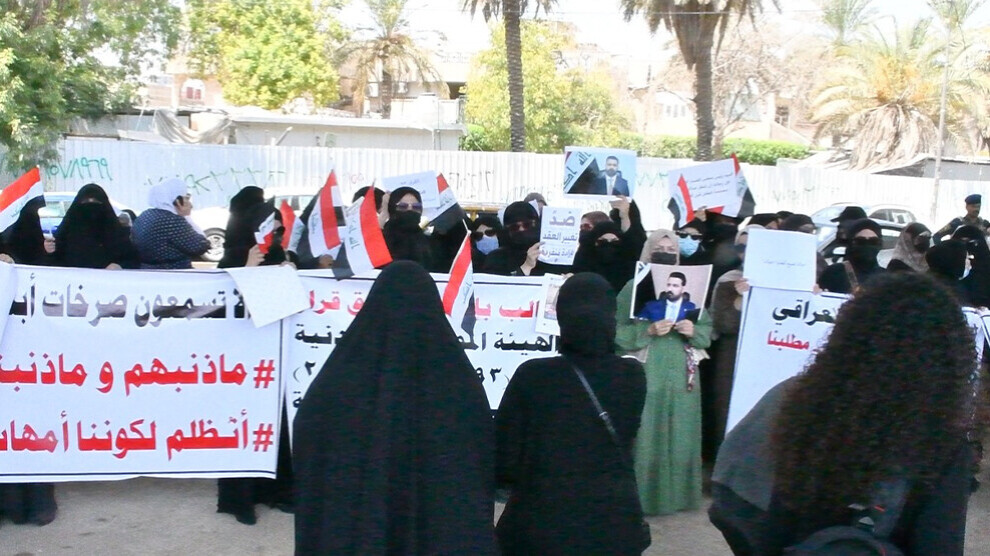
Demands from Iraqi mothers have escalated regarding the repercussions of applying the provisions of the Ja'fari Code on marriage contracts and custody cases, amid fears over the impact of legal amendments and new judicial rulings on family stability and children's futures. In a protest vigil in front of the Supreme Judicial Council in Baghdad today, Friday, August 14, participants demanded a review of Judicial Decision No. (93) and ensuring that the rights of mothers and children are not violated, in addition to rejecting the alteration or conversion of existing marriage contracts without the knowledge or consent of the other party.
In contrast, some of the protesters base their arguments regarding marriage contract conditions on what is published on the official website of the supreme religious authority, Ayatollah Ali al-Sistani, which explains that a marriage contract is based on offer and acceptance, and further affirms that one of the contract's conditions is the actual consent of both spouses.
Review of Law Enforcement Mechanisms
In this context, activist Shaima Al-Maamouri stated that the protesters' demands are firstly to cancel contracts that women consider contrary to Sharia and the law, noting that they rely in this regard on fatwas published on Ayatollah Ali al-Sistani's official website.
She noted that the second demand is to reject the unilateral conversion of women's contracts to the provisions of the Ja'fari Code without their consent or knowledge, explaining that among the protesters are women who have been married for many years—some for more than five or ten years—and have children, before receiving notifications regarding their transfer to the application of the Code.
She affirmed that the protesters believe that the choice of personal status provisions should be clear and known to the concerned parties, calling for a review of the mechanisms of law application to prevent, from their perspective, sudden changes in stable family situations.
She also noted that the issue of child custody represents a fundamental aspect of the protest, particularly regarding the interpretation of the Code's provisions and their effects on children, considering that transferring a child from the environment they are accustomed to to another environment requires studying their circumstances, interests, and the suitability of the new environment.
The Child's Interest and Safety First
For her part, one of the protesting mothers stated that a number of mothers are living in a state of anxiety and fear due to what she described as the possibility of losing their children, affirming that the mother's demand does not exceed ensuring her right to care for her children and reassurance about their future. "Children should not be a party to conflicts between parents. Any decision concerning a child's fate must prioritize their interest and psychological and social well-being."
She added that the mother who follows her child's daily life—from education and health to various needs—and sees that losing them represents a great shock, and that the effects of any custody dispute are not limited to the parents but may extend to the child themselves. She affirmed that mothers' demands are not only about retaining custody but also about the existence of fair and transparent mechanisms that guarantee the rights of all parties, while maintaining children's stability and providing a supportive family environment.
She called on judicial and legislative authorities to listen to mothers' demands and consider their concerns seriously, affirming that family disputes should be resolved in a way that does not make children pay the price of conflicts between their relatives.
The protest comes as the amendment to the Personal Status Law No. (188) of 1959 comes into effect, following the issuance of Law No. (1) of 2025, which allows Muslim Iraqi men and women to choose the application of the Ja'fari Shiite school of jurisprudence in personal status matters, and also allows, in specific cases, the submission of requests to apply these provisions to previous marriage contracts.