
“Bîranîn”Echibition… Memory of North Kurdistan Through the Eyes of Field Journalism
The Bîranîn exhibition reveals North Kurdistan’s reality through testimonies gathered by two journalists over three months, highlighting residents’ memories and daily lives.
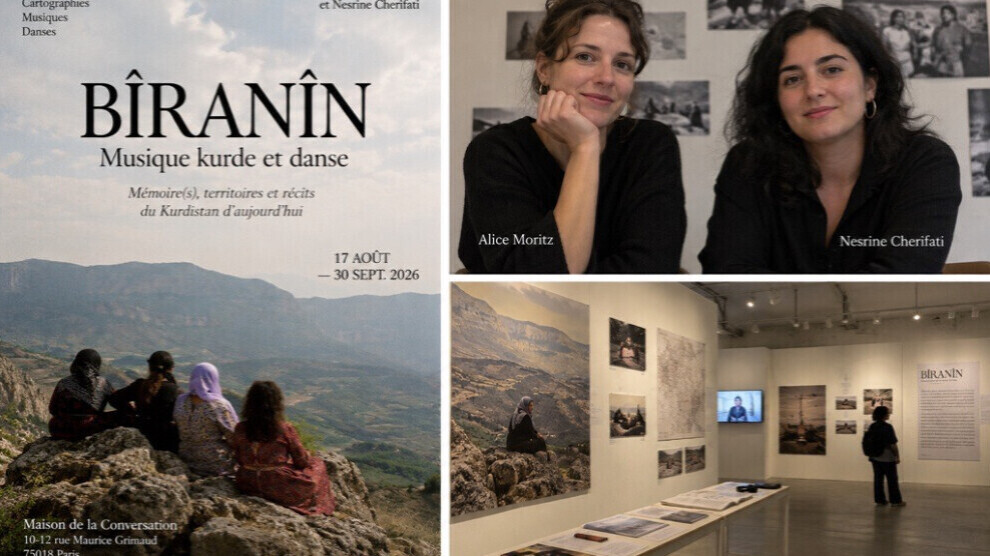
Paris_ The “Bîranîn” Project presents itself as a documentary work reading the reality of North Kurdistan, based on a filed study that uncovered residents’ testimonies and experiences extending beyond the limits of traditional news coverage.
The “Bîranîn” ex hibition opened at the Dar Al‑Hiwar in Paris, presenting an expanded vision of North Kurdistan from the perspective of independent women journalists, based on fieldwork and documentation that extended over several months. The project was carried out by journalists Alice Moritz and Nasrin Sharifati, who conducted a three‑month field study in North Kurdistan to document the Kurdish issue, observe daily life, and collect residents' testimonies and direct experiences.
The work included producing research materials, filming videos, and writing reports and articles, all presented within diverse content in the "Bîranîn" exhibition.
The exhibition is not limited to presenting published journalistic results but also highlights the human and professional experiences that accompany journalistic work behind the scenes, which often remain outside traditional news texts, offering a deeper view of the nature and complexities of the field.
The exhibition features photographs, historical materials, regional historical studies, maps, documentary films, and archival materials. The project aims to enable viewers to see not only the final result of a news story or research but also the realities and experiences encountered during fieldwork.
According to the organizers, behind every documentary film and every news report lie hundreds of hours of fieldwork, nights spent in local residents' homes, spontaneous conversations, and glimpses of daily life. These small moments, which often find no place in traditional news and reports, become an important part of the narrative of "Bîranîn."
The exhibition's title also points to the project's fundamental approach. In Kurdish, the word "Bîranîn" means remembrance, recalling the past and preserving lived experiences. Accordingly, the project is not limited to addressing memory through documents stored in archives but also focuses on the relationship created through music, dance, and people's personal stories.
Kurdish music was also presented at the exhibition's opening. Deza Ahmed, who performed traditional Kurdish music, delivered a performance that carried the memory and stories of the Kurdish people to new generations through melodies and tunes. Kurdish dancer, actor, and activist Khwan Gulan Elibeg also performed a dance as part of the event.
A central aspect of this project is the presence of journalists Alice Moritz and Nasrin Sharifati as part of the story, not merely as its transmitters. They worked in North Kurdistan for three months, directly witnessing events, which enabled them to document field observations and closely monitor residents' experiences.
During their work, the journalists met with residents, listened to their narratives, and recorded their testimonies in an attempt to capture the voices often marginalized in traditional media narratives. From this perspective, the "Bîranîn" exhibition brings these voices back to the center of the story, presenting a documentary approach that highlights the human dimension behind news and reports.
As part of the exhibition, a market showcasing products from Kurdish producers will be held today, Saturday, September 5. On September 10, documentary films will be screened and a panel discussion on issues related to North Kurdistan will be held. The exhibition will continue until the end of the month.