
Art Exhibition in Suwayda Documents the Events of July and Immortalizes Souls of the Victims
An art exhibition at Suwayda National Hospital commemorated the July events, documenting violations and reviving collective memory through powerful artworks that depicted the local population's immense suffering and resilient spirit.
ROCHELLE JUNIOR
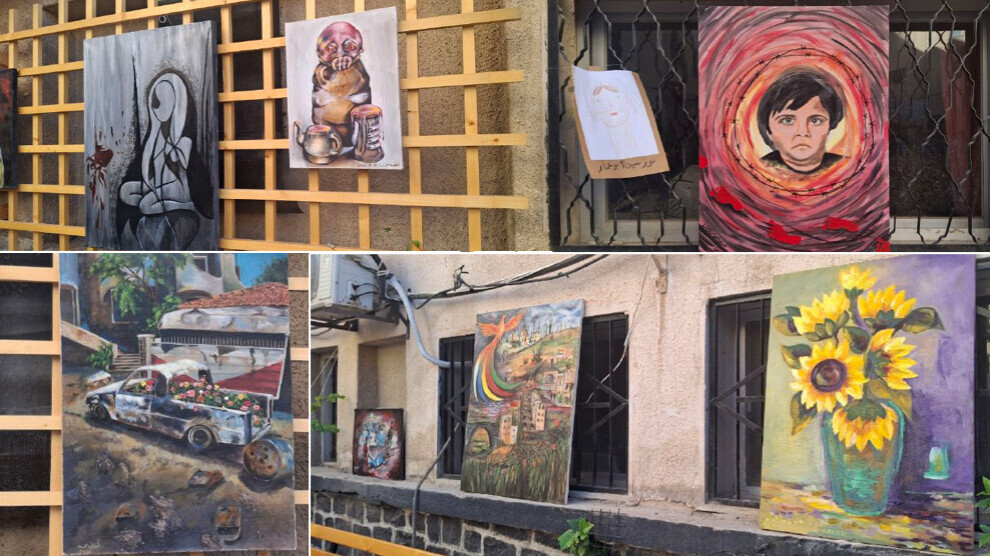
Suwayda — Participants in the art exhibition commemorated the events of July witnessed by the city of Suwayda, emphasizing that the event aimed to revive collective memory and document the violations that occurred at the Suwayda National Hospital through artworks carrying multiple messages.
At the invitation of the "Basalt" Foundation for Cinema and Television Production, the garden of the Suwayda National Hospital hosted an art exhibition yesterday, Monday, July 13. A number of male and female artists participated, presenting paintings inspired by the events of July 2025 to immortalize the souls of the victims and document the events witnessed by the hospital, with the aim of keeping memory alive through art.
The exhibition was held at the exact site that witnessed violations against civilians. The organizers pointed out that the Suwayda National Hospital was subjected to systematic strikes and a raid, during which several medical staff members and patients were killed. They added that international laws and conventions stipulate the neutralization of hospitals and keeping them away from armed conflicts; however, what transpired in Suwayda ran entirely contrary to these principles.
"The Search for Safety"
Fine arts student Rahaf Harb shared that she drew inspiration for her painting from the clay jars found in traditional Arab homes in Suwayda. She explained that when the massacres occurred, many felt a desperate need for a place to shield themselves from fear, killing, and bloodshed. She depicted this feeling through a figure hiding inside a clay jar—even though it is too small to accommodate them—to express the sheer terror that drives a human being to search for any sanctuary, no matter how small.
She noted that the painting also conveys the feeling that the land of one's birth no longer embraces them or feels safe. She represented this through the color white, symbolizing silence and emptiness, as if a person can no longer find anything to lean on. As for the water pouring from the jar, she explained that it symbolizes the overwhelming emotions experienced by the residents, while the facial features reflect the state of fear, pain, and panic that accompanied those days.
"A Strong People Living on Hope"
For her part, artist Amani Bahah said her painting tells the story of a group of young men from her village, "Sali," who were defending their area during the events of "Black July 15." During the clashes, the vehicle they were traveling in was struck by a drone, severely injuring five young men, including one whom she described as a "living martyr" after losing his leg to amputation.
She pointed out that the painting represents a message of gratitude and appreciation to these young men, which is the least she could offer them as an artist. She noted that she depicted devastation and ruin in the painting, but added roses as a symbol of hope because the people of Suwayda are resilient and live on hope, which enabled them to rise again from the rubble. She added that the site of the incident has now returned to life, and her participation came as part of an initiative organized by the Basalt Foundation in the "Garden of Hope"—a place that was filled with the bodies of victims during the events but has now become full of life, which is what she sought to express in her artwork.
"The Voice of Truth"
Fine artist Raghad Noufal stated that holding the exhibition inside the Suwayda National Hospital, which witnessed massacres in July 2025, carries a profound message. She emphasized that the role of artists is to convey the "voice of truth" and embody reality through paintings and human emotions.
She explained that she used red in her paintings to represent the blood of the victims, black to depict the brutality of the crime, and white to portray the doctors, their humanitarian mission, and the chivalry they demonstrated, alongside highlighting the well-known customs and traditions of the people of Suwayda.
"The Pictures on the Walls Bear Witness to the Screams"
In turn, participant Tijan Shalhoub explained that the passing of a year since the events of July brings back memories of the "bloody massacre" witnessed by Suwayda. She noted that the city, known for its civil society striving for culture and thought, was subjected to an identity-based attack targeting its residents.
She added that the Suwayda National Hospital was besieged for more than 24 hours while holding hundreds of bodies of civilians who had nothing to do with the conflict other than trying to survive. She pointed out that while the place was once filled with destruction and blood, the people of Suwayda sought to transform it into a space of hope. They planted roses in the "Garden of Hope" where every drop of blood had spilled and hung pictures on the walls that had once witnessed the screams of the wounded and the pain of bereaved mothers, sending a message that asserts their adherence to life despite everything that happened.
She praised the stance of the medical staff, confirming that they refused to leave the hospital despite the dangers. She recounted the story of a nurse who continued working for an entire week without sleep, refusing to leave her department to help patients despite the complete siege of Suwayda, the acute shortage of medical equipment, and the residents' reliance on individual efforts to provide aid.