
A Low-Pressure System in Gaza Turns a Mother’s Joy into a Tragedy
In a fleeting moment meant for her child’s laughter, Ikhlas Al-Tawil’s life became tragedy when a concrete slab crushed her back in a dilapidated refuge, leaving her paraplegic and immobile. Rafeef Islim
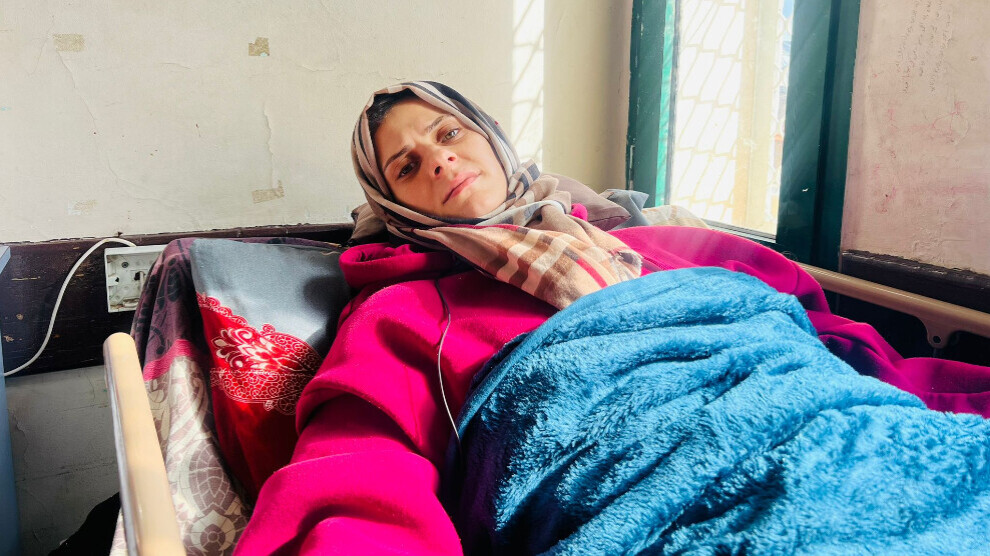
Gaza — Thousands of families in the Gaza Strip are living under harsh conditions imposed by displacement, forcing them to seek shelter in dilapidated houses unfit for habitation—especially as winter storms intensify across the region. The story of Ikhlas Al-Tawil reveals a dark side of the suffering endured by displaced people: caught between houses at risk of collapse and tents that offer no protection from the cold, they face impossible choices.
Ikhlas Al-Tawil sustained paraplegia in the lower half of her body while playing with her child in a collapsing house she had fled to in the southern Gaza Strip, during the first winter low-pressure systems to hit the area.
Al-Tawil says that on December 12 she suffered a painful accident caused by the storm, after being displaced to a dilapidated house in southern Gaza following the destruction of her home—attached to a garden in the Safatawi neighborhood in northern Gaza—by Israeli forces. She notes that she was forced to live in a house she knew well was at risk of collapse and could threaten her life, yet it remained less cruel than a tent and the suffering it entails.
She explains: “We live in a city surrounded by rubble from every direction, with no place fit for a humane life. We therefore find ourselves facing two equally bitter options: a tent that neither protects us from the cold nor preserves our dignity, or a collapsing house. Despite the high rent of these houses, I am forced to pay it from my savings at the expense of my physical and mental health. And today I bear this burden alone, leaving four young children without a provider—the eldest is seven years old and the youngest has not yet reached three and a half.”
According to doctors, the accident resulted in a fracture of the first lumbar vertebra of the spine, in addition to pressure on the spinal cord that led to paraplegia in the lower part of her body. Although she was immediately transferred to hospital and admitted to the operating room urgently in an attempt to save what could be saved, she still requires immediate and urgent medical rehabilitation to regain as much mobility as possible.
Al-Tawil explains that medical and neurological rehabilitation is no longer a secondary option, but the only hope for restoring her ability to live a normal life. She spends her days and nights lying on her back, unable to sit or move independently. Worse still, she says, Gaza has only two rehabilitation centers—Hamad Hospital and Al-Wafa Hospital—neither of which provides services that would even allow her to sit without assistance, let alone regain her ability to walk.
What troubles Al-Tawil most and deepens her anxiety is that her father had suffered from paraplegia; she knows well the stages of treatment and the time and meticulous care it requires. She therefore fully realizes the importance of urgently transferring her outside the Gaza Strip for treatment. Doctors’ attempts to reassure her do little to ease her psychological collapse, which worsens whenever she feels sensation fading from the lower part of her body, as if each nerve is snapping one by one, step after step.
She says: “What my body is going through now is stiffness in the bones, muscle atrophy, and a gradual loss of sensation in tendons I could feel moving just days ago. It seems my body has begun to treat those nerves as if they no longer exist.” She adds that since December 15 she should have been in a physiotherapy center, receiving appropriate exercises and specialized care using equipment unavailable in Gaza. Instead, she remains stretched out on a bed all the time, receiving only painkillers at night, with no therapeutic intervention to help her recover what she loses day after day.
What is needed is not a miracle, but medical and psychological rehabilitation and advanced equipment designed to deal with cases of paraplegia—measures capable of giving Ikhlas Al-Tawil a chance to live a normal life like other women her age. This is not a rare medical case.
Al-Tawil finds solace in one thought that eases her suffering: that she was the one who took the impact of the falling concrete column, not her three-year-old child, who would have certainly lost his life had he been struck. “I bear the pain, the loss, the disability, and all the countless hardships that fall upon me, but I cannot bear to live a single day without my little child. So every day I console myself that he survived, that he is able to live, play, and run like other children his age.”
Her young children are also suffering psychologically. Although they are living under the care of their paternal grandmother, they miss their mother every moment. The new life imposed on them is completely different and requires a long time to adapt to. She notes that from the very first moment of her injury, before she was transferred anywhere, she thought only of her children and fully grasped the magnitude of the disaster that had befallen her—especially when she completely lost sensation in the lower part of her body.
Ikhlas Al-Tawil can no longer even bear to think about that house. The mere image of it in her mind brings back the moment of the accident and all the pain that accompanied it, triggering a nervous breakdown followed by a severe deterioration in her health and a sharp drop in blood pressure. She therefore affirms that she will never return to it. Because of that house, she finds herself today injured, homeless, and in urgent need of treatment outside the Gaza Strip—while it seems no one is paying attention to her suffering or seeking to save what remains of her health.