
Saturday Mothers… when waiting turns into resistance
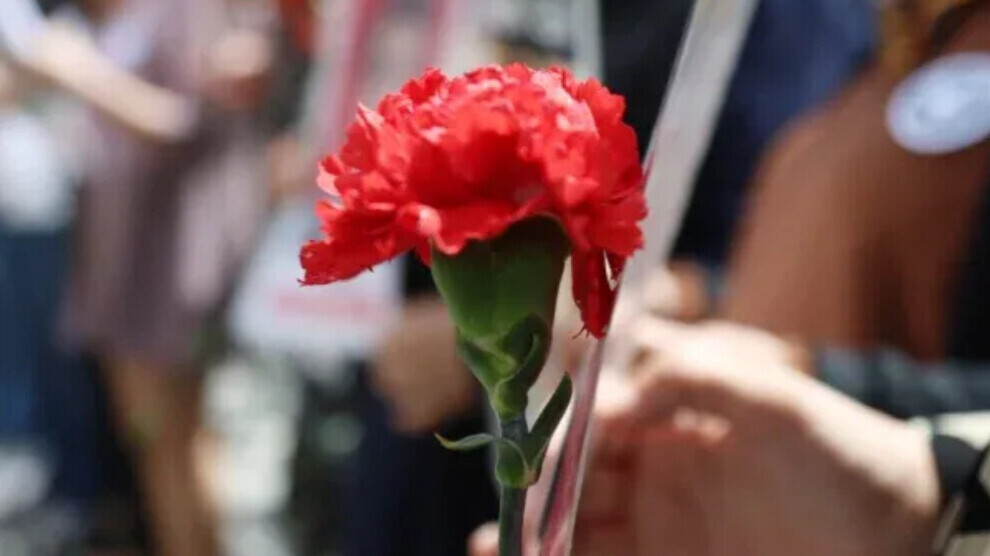
For years, families of missing gather, carrying carnations and photos, asking ‘Where are they?’ this waiting has become an unrelenting cry against injustice, a persistent voice for truth and justice.
Sarya Deniz
News Center – The song "Saturday" begins with the words: "Days pass while we wait… Today is deaf and mute, and the nightingales have fallen silent… Ah, I am a mother… My heart will not burn even if they place embers upon it. You cannot steal my hope, even if I die, my pain will stain the pages of history."
In these words, not only the sadness of a song is reflected, but also the pain that has not faded for years in the hearts of mothers who still ask about the fate of their children. During the Week of the Disappeared, the same question returns with greater force in the squares: When will those responsible for those who disappeared while in custody be held accountable?
In Taksim Square, and in Amed (Diyarbakır), Batman, İzmir, and Van, those waiting still stand holding faded photographs. Despite all these years, they have not abandoned the traces of their children, husbands, and brothers, nor the demand for justice.
The words "The spirit is lost, the spirit is lost… My God, what kind of world is this, and what shame" remain the voice of wounds that have not healed in the memory of Turkey and North Kurdistan. Today, as talk of peace and reconciliation resumes, the demands of the Saturday Mothers for truth become even more urgent. They always say: "You cannot steal my hope… even if I die, my pain will stain the pages of history."
Everything begins with confronting the truth
The renewed debate in Turkey about peace and a democratic solution has brought back to the forefront the reality of enforced disappearances and unsolved murders that have been left in the shadows for years. During the Week of the Disappeared events, human rights defenders and families of the missing stressed that "there is no lasting peace without confronting the truth," calling on the state to confront the crimes committed in the past, reveal the fate of the missing, and end the policy of impunity.
Statements highlighting the ongoing struggle of the Saturday Mothers for 31 years affirmed that a democratic society can only be achieved by uncovering the crimes of enforced disappearance and restoring community memory.
A search that has continued for 31 years
Since 1995, the Human Rights Association has observed the period between May 17 and 31 as the "Week of the Disappeared," aiming to promote confronting the truth about enforced disappearances in Turkey and the world, reveal the fate of the missing, and ensure accountability for those responsible.
For 31 years, families of the missing and human rights defenders have continued to raise their voices for truth, especially in front of the Galatasaray High School in Beyoğlu, Istanbul, as well as in Amed, Batman, Şırnak, Hakkari, Dersim, İzmir, Ankara, Adana, Mersin, Van, and other cities.
State policy
According to historical data, the roots of enforced disappearance policies go back to the repressive policies adopted by Nazi Germany during World War II. During that period, authorities specifically targeted political opponents, Jews, and groups of ethnicities or so‑called "minorities" within a systematic state‑organized system of violence, of which "denial" was an essential part.
In 1941, the so‑called "Night and Fog Decree" was implemented, stipulating the secret arrest of resistance fighters in occupied countries and their transfer to Germany, where trials were conducted in complete secrecy, with no information given to families about the fate of detainees. This policy was seen as a means to spread fear and ambiguity and suppress resistance movements.
Re‑emergence after years
After the war, enforced disappearance practices remained for many years without a clear definition or binding framework in international law. However, during the 1960s and 1970s, these practices re‑emerged strongly, especially in Latin American countries, where they became state policy in countries such as Guatemala, Brazil, Argentina, Chile, Peru, El Salvador, Uruguay, and Honduras.
During that period, thousands of people disappeared forcibly. In many cases, bodies were also hidden, and officials escaped judicial accountability. In Argentina, an official commission announced that the number of disappeared people was at least 8,960, noting that the actual number may be much higher.
The 1980s and beyond
Since the 1980s, enforced disappearance has not been limited to Latin America; it has spread to other regions such as Iraq, Iran, Algeria, and Sri Lanka.
In areas that witnessed internal conflicts or tightened security policies, this practice turned into a systematic tool for suppressing opponents. Tens of thousands of cases of disappearance have been recorded in both Sri Lanka and Iraq, and many of these cases remain unresolved to this day.
The absence or concealment of detention records in some countries has further complicated efforts to reveal the fate of the missing and access the truth.
The struggle continues
At the international level, special mechanisms were established within the UN to monitor and document cases of enforced disappearance, but the limited powers of these mechanisms long prevented the creation of a binding and effective legal system. With the subsequent adoption of international and regional conventions, the definition of enforced disappearance was clarified more precisely, but global efforts to eliminate it continue to this day.
What is enforced disappearance?
According to the International Convention for the Protection of All Persons from Enforced Disappearance, "enforced disappearance" means the arrest, detention, abduction, or any other form of deprivation of liberty by state agents, or by persons or groups acting with the authorization, support, or acquiescence of the state, followed by a refusal to acknowledge the deprivation of liberty or by concealment of the fate or whereabouts of the disappeared person.
This also means placing the person outside the protection of the law. This definition is based on three essential elements: deprivation of liberty against the person's will; involvement of the state directly or through silence or complicity; and deliberate concealment of the person's fate or whereabouts or denial of their detention.
What does the Convention say?
Today, the families of thousands of missing persons in Turkey and North Kurdistan also demand the adoption of the International Convention for the Protection of All Persons from Enforced Disappearance, adopted by the UN General Assembly on December 20, 2006, opened for signature on February 7, 2007, and entered into force on December 23, 2010. To date, 98 countries have signed it, and 76 have acceded to it, while Turkey has not yet signed.
The Convention obliges states to criminalize enforced disappearance, investigate cases, hold perpetrators accountable, and recognize the rights of families of the missing. It also provides for the establishment of a special committee called the "Committee on Enforced Disappearances" to monitor implementation.
The Convention affirms that "no one shall be subjected to enforced disappearance" and that "this crime cannot be justified under any exceptional circumstances, including a state of war, threat of war, internal political instability, or any other public emergency." It also stresses that revealing the fate of the missing and ending the policy of impunity are essential conditions for achieving justice.
The missing in Turkey
In Turkey, it is known that cases of enforced disappearance were not limited to the period after the September 12, 1980 coup; they also emerged systematically during the 1990s during the state of emergency (OHAL), when violations escalated markedly.
Human rights organizations, such as the Human Rights Association and the Human Rights Foundation of Turkey, continue to document these cases through their own records, in the absence of comprehensive official data from the state. Reports from these institutions indicate hundreds of disappearances, with the understanding that the actual number may be much higher.
In some cases, the fate of persons has never been revealed; in others, even the bodies have not been recovered. While the discovery of some mass graves has provided partial evidence, it has not ended the state of ambiguity in which families live, which is a source of deep psychological and social suffering.
In the squares since 1995
Since 1995, families of the missing have gathered weekly to demand justice. Women often lead this movement. The "Saturday Mothers" movement has continued its vigil every Saturday since May 27, 1995, in Taksim Square, carrying carnations and photos of loved ones in a battle for truth and justice.
The "Mothers of Peace" also demand to know the fate of the missing through their white headscarves. Despite facing repression in many countries, including arrest, torture, and detention, the families of the missing in Turkey have not abandoned the squares.
One song summarizes this ongoing pain with the words:
"Come closer to me, my mother…
Two policemen are by my side…
My hands are tied…
Search for me, my mother…"