
Women Erased from Urban Symbols: lefts Out of history and Culture
The dominance of male statues and symbols in Kermanshah erases women from public spaces and collective memory, reinforcing a single historical narrative, perpetuating gender inequality, and limiting female heroic role models for future generations.
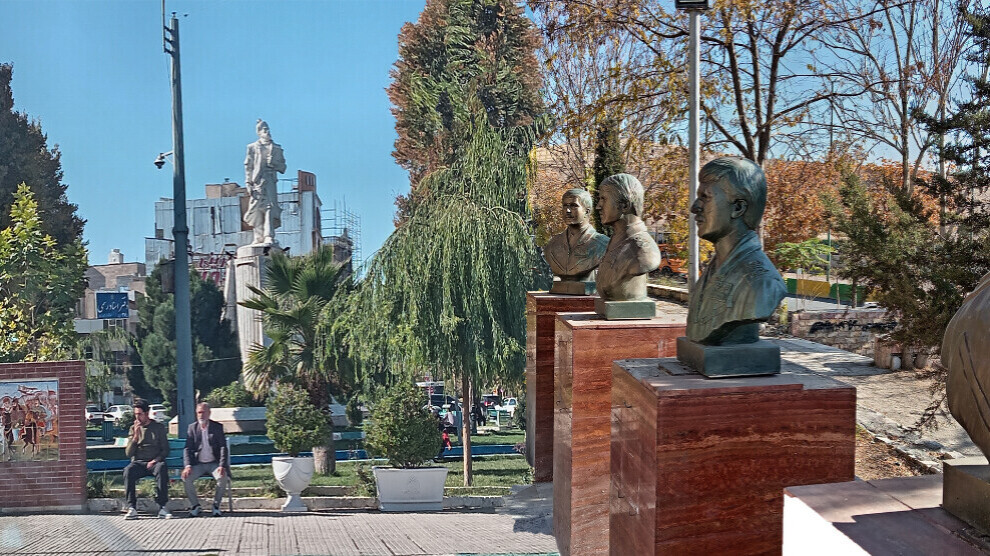
Kermanshah_ Legends say the worship of idols ended with the first blows of Abraham’s axe.Yet visual historical evidence tells a different story:the idols were never truly destroyed but reappeared in a new form—this time as men installed alone for veneration and reverence. In public squares, main streets, and the entrances of major institutions, the image of the male statue is repeatedly erected for admiration, while women are completely absent—no female figures recall collective memory or represent their share of history.
Walking through the streets of Kermanshah in Eastern Kurdistan, one is confronted by these imposed idols, with cold, unyielding eyes, as if even in their stone bodies, men declare their supremacy over everything. These statues are not mere silent stones; they are encoded messages asserting that the hero, conqueror, thinker, and worthy of admiration is always a man.
Symbolic Exclusion of Women… Normalizing Gender Inequality
Excluding women from the city’s visual memory means erasing them from its history and future. Girls and women pass by these statues daily, internalizing the idea that they have no place in the public narrative. Through its stone monuments, the city reproduces a male-centered story, placing men in the position of idols—not in temples anymore, but in the heart of urban spaces—yet still performing the same function: consolidating authority, asserting dominance, and perpetuating rituals of veneration.
Despite this male supremacy embodied in statues, it has yet to become a serious social or cultural issue. The overwhelming presence of male figures in public spaces reflects not only a historically male-dominated artistic and architectural legacy but also a conscious or unconscious erasure of women from collective memory and urban symbols. Over time, this absence becomes a visual and cultural habit, rarely challenged or criticized, thereby reinforcing the reproduction of gender inequality in symbolic spaces. In this sense, excluding women from monuments represents a form of “normalized” inequality, treating their absence from symbolic spaces as natural.
In this context, Kermanshah-based artist and sculptor Somaya Y. criticized the dominance of male symbols in urban spaces, explaining:
“Men’s presence in the city’s visual landscape goes beyond what is immediately apparent. In recent years, Kermanshah Municipality has erected numerous statues across the city, most of which depict male faces and leaders.”
This repeated choice has, according to her, made her as a sculptor less attentive to the absence of women’s statues—or even questioning why influential female figures are so rarely represented. She noted that Kermanshah hosts only one statue of a woman, near Shirin Park, and ironically, it is usually described as “a woman who fought in a masculine way.” This description reveals the persistence of male-centered perspectives even in representing women, measuring their presence by standards of strength and heroism traditionally associated with men.
Public Space Reproduces Male Authority Through Statues
Depicting men as heroes in narratives, history, and commemorative statues is nothing more than a reproduction of male-centered structures that have sought, for centuries, to marginalize women’s voices and minimize their presence. These narratives and symbols not only highlight male presence but also exclude or distort the role of women, creating a one-sided view of history and literature. In many historical and literary accounts, women rarely appear as independent heroines; they are often portrayed as “villains” or “deceitful” figures whose only function is to mislead the male hero and divert him from his path.
Only in rare cases is a woman depicted as a heroine, and even then, her role is defined in service of a man or to support his heroic journey. This model clearly demonstrates how cultural and social systems, through the use of literary and historical narratives, have reproduced and reinforced patriarchal structures. Women are thus rarely represented as autonomous actors, but as instruments completing a male-centered story.
This exclusion not only erases women’s real experiences from collective memory but also limits the possibility of creating female heroic models. A critical reading of these narratives opens the door to recovering silenced women’s voices and redefining heroism in history and literature—heroism based on resistance, independence, and active participation in social life, rather than merely serving men.
Men’s Statues in Kermanshah: A Singular Collective Memory
In Kermanshah, hundreds of statues depict male heroes, clearly reflecting the dominance of male perspectives in collective memory and urban cultural policies. These choices do more than emphasize male-centered history and mythology—they also reveal the stark absence of female heroes, artists, and social actors. This approach sidelines women while depriving new generations of exposure to female models of struggle, knowledge, and artistry.
This symbolic absence is not merely an aesthetic or artistic issue; it directly reflects structures of power and collective memory policies embedded in public space. Although Kermanshah’s history is rich with female poets, activists, artists, and social contributors, excluding them from urban symbols effectively removes them from the official narrative of history. Over time, this exclusion produces a singular social memory, limiting the creation of diverse role models for future generations.
Public statues and symbols do more than reflect the past; they shape the cultural future. When men alone are presented as the city’s heroes, the implicit message is that women have no role in shaping history and culture. This unspoken message influences collective consciousness and reinforces the reproduction of gender inequality in social and cultural spheres, where the patriarchal system seeks to maintain authority even through cold, stone bodies.